Part 16 told the GPU's history as Nvidia's, and Part 17 as ATI's and AMD's. Intel's is a different kind of story. Measured in units, Intel has been the largest maker of GPUs in the world for most of the last twenty-five years, because nearly every PC with an Intel processor has had Intel graphics in it. Measured in big GPUs, the kind this series is mostly about, it has tried four times, with a graphics card in 1998, a many-core x86 chip around 2009, the Xe architecture from 2018, and a series of data-centre accelerators, and none of the four has yet given it a lasting place beside the other two. This part is why, told in the same way as the two before it.
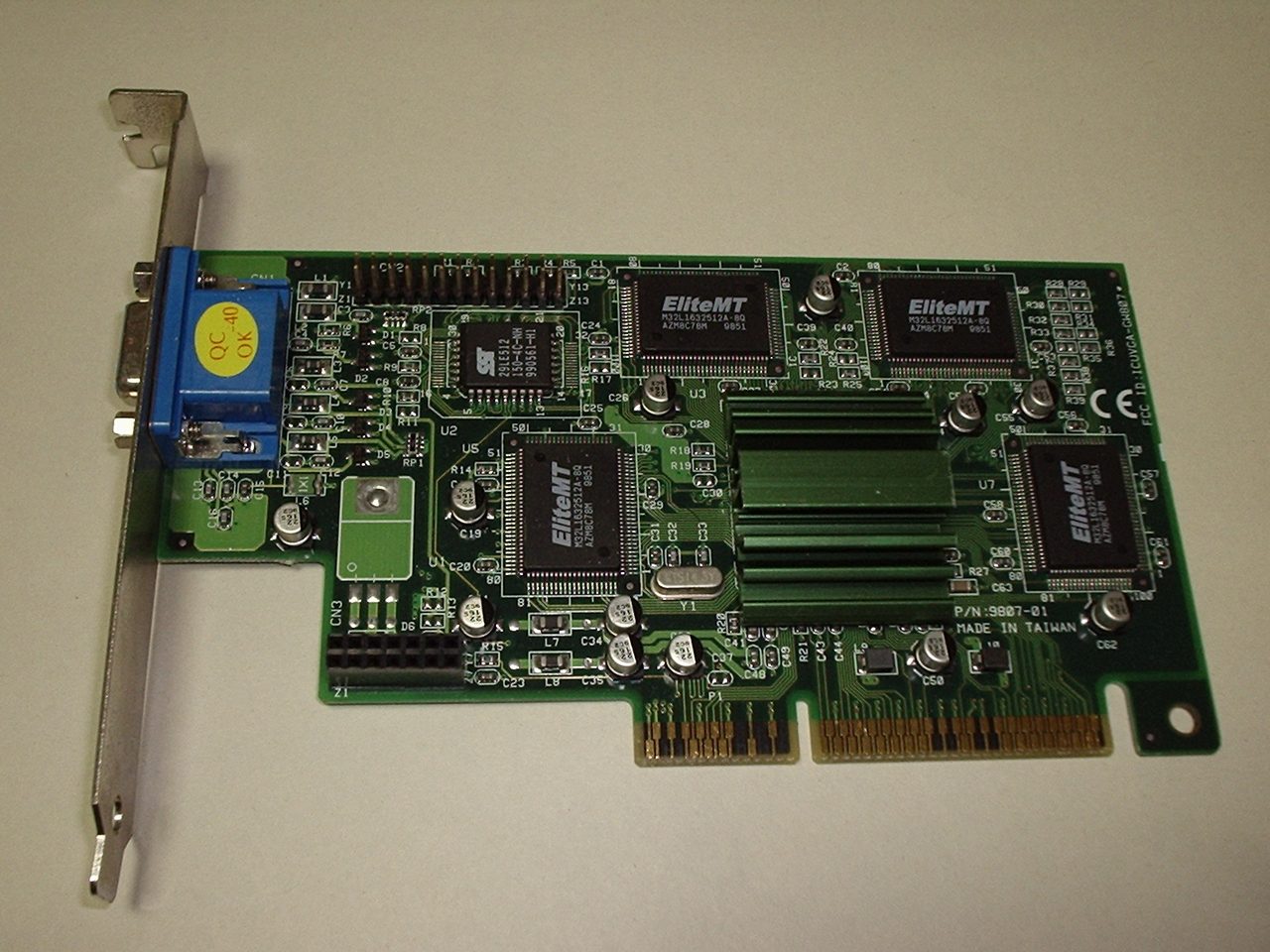
Attempt one: the i740 (1998)
Intel's first graphics chip came out of a partnership with Real3D, a division of Lockheed Martin that had built image generators for flight simulators, and it was launched in February 1998 as the Intel740. It was designed around an idea Intel was promoting at the time, the Accelerated Graphics Port, a dedicated slot that let a graphics card read the computer's main memory quickly, and the i740 relied on it, keeping its textures in main memory rather than on the card. It was cheap and briefly popular, about four million sold, and then it was overtaken within months by cards from Nvidia, 3dfx and ATI that kept their textures in fast memory of their own, which turned out to matter far more than Intel had bet. It is the memory wall of Part 7 again, met at the very start. By the end of 1999 Intel had stopped making discrete graphics chips and bought what remained of Real3D.
What it kept was the graphics design, and it put it somewhere no competitor could follow. Intel's 810 chipset of 1999 built the graphics into the chip that connected the processor to the rest of the computer, so that a PC needed no graphics card at all for office work, and for the next decade most cheap and middling PCs and laptops shipped with Intel graphics inside their chipsets, under names that changed every few years: Extreme Graphics, then the Graphics Media Accelerator. It was never fast. It did not have to be. It was free, in the sense that it came with the chipset, and that made Intel by far the largest seller of GPUs in the world.
Onto the processor (2010 to 2017)
The next step was to move the graphics from the chipset into the processor. Intel put it in the same package as the CPU in 2010, and in January 2011, with the Sandy Bridge processors, onto the same piece of silicon, sharing the processor's cache and its connection to memory. Sandy Bridge also brought Quick Sync, a block of fixed-function hardware for encoding video, which gave even cheap Intel laptops fast video encoding and is one reason Intel's media engines are still well regarded. From then on the GPU was simply part of the processor, and its execution units, the ancestors of the vector engines of Part 11, multiplied with each generation, from twelve in the larger Sandy Bridge graphics to forty in the Iris Pro of 2013, which added 128 MB of embedded DRAM on a separate die in the package as a cache, an early relative of the Infinity Cache of Part 22.
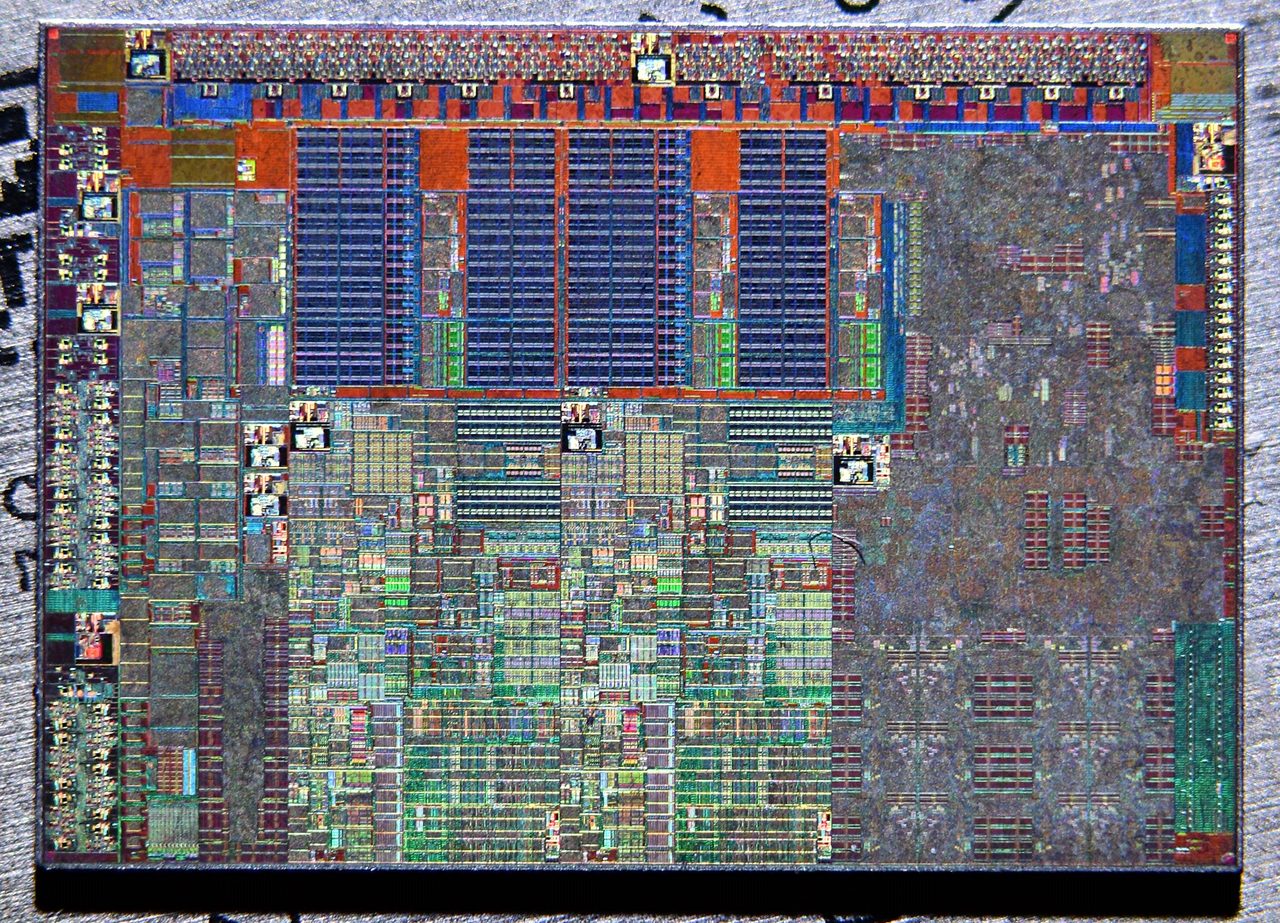
Integrated graphics are still the most common GPUs in the world, and they matter to this series for a reason beyond numbers. They are the chips on which Intel learned how to build a GPU: the compiler that chooses a SIMD width for each shader, the fixed register seats, the vector engines that reach memory by sending messages, all of Part 11, come from fifteen years of designing graphics that had to share a die, a power budget and a memory with a CPU.
Attempt two: Larrabee and Xeon Phi (2006 to 2020)
In 2006, with graphics chips turning into the general-purpose machines of Part 16, Intel began a project to build a GPU its own way. Larrabee, described publicly in a paper at the SIGGRAPH conference in 2008, was to be dozens of small x86 processor cores, simple in-order designs descended from the original Pentium, each with a 512-bit vector unit that could work on sixteen 32-bit numbers at once and four threads to switch between, joined by a ring and sharing a large coherent cache. There would be almost no fixed-function graphics hardware. Rasterising, blending and the rest of Part 20's pipeline would be done in software, on the x86 cores, so that the whole chip would be programmable in ordinary C with the tools every programmer already had.
It did not work as a graphics card. On 4 December 2009 Intel announced that the first Larrabee would not be released as a graphics product. The cores and their x86 decoders, caches and coherence cost far more silicon per lane than a GPU's lanes, the software renderer could not match fixed-function hardware at the same power, and the chip was late. Part 6's argument, that a GPU wins by spending its transistors on lanes rather than on the machinery of a general-purpose core, was being made against Intel's own design.
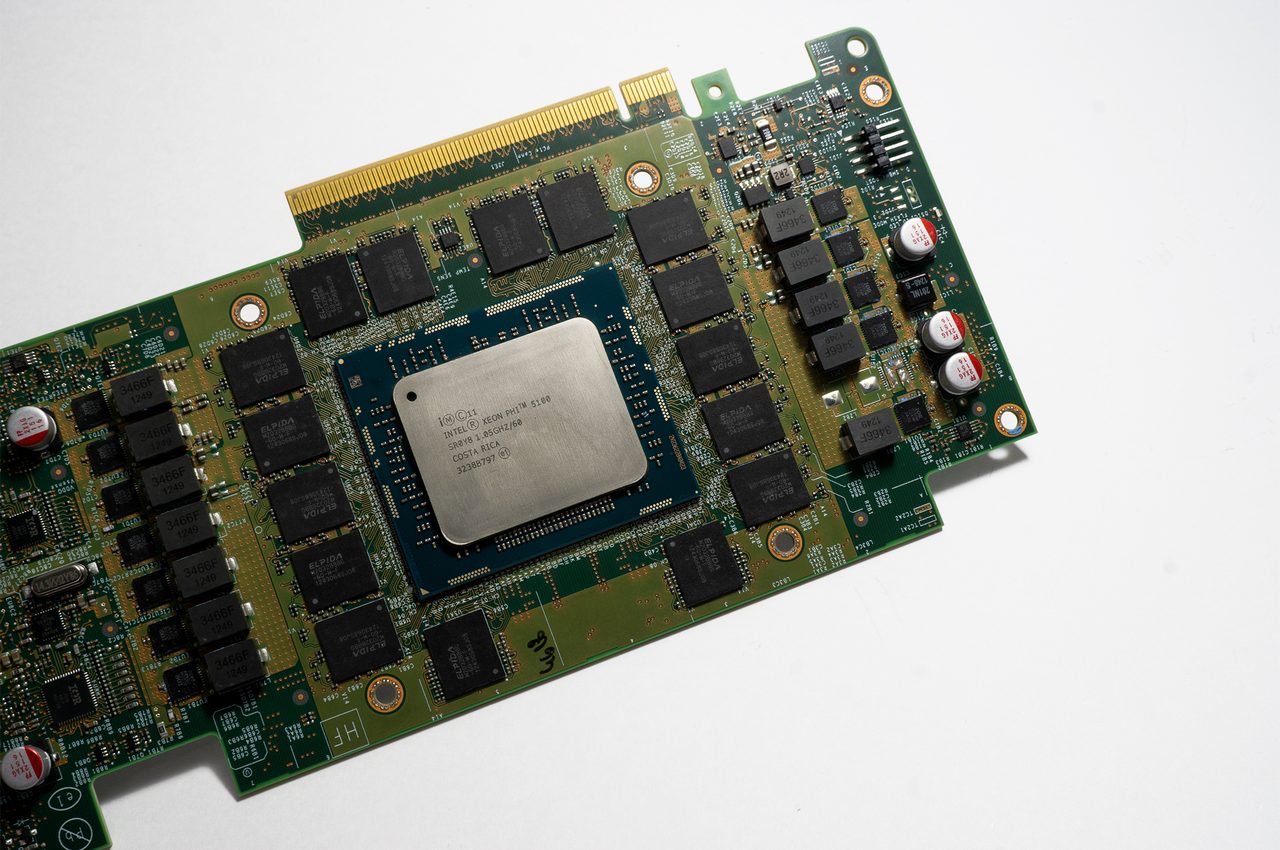
The chip lived on in computing. It became a development platform, Knights Ferry, then the Xeon Phi coprocessor of 2012, Knights Corner, a card with about sixty of the x86 cores. Xeon Phi powered China's Tianhe-2, the fastest supercomputer in the world from 2013 to 2015, and in 2016 Knights Landing became a standalone processor with 16 GB of stacked memory in its package. Then the line stopped: Intel announced the end of Xeon Phi in 2018 and shipped the last ones by 2020. Its lasting legacy is in every Intel server processor today. The 512-bit vector instructions designed for Larrabee became AVX-512.
Attempt three: Xe and Arc (2017 to 2024)
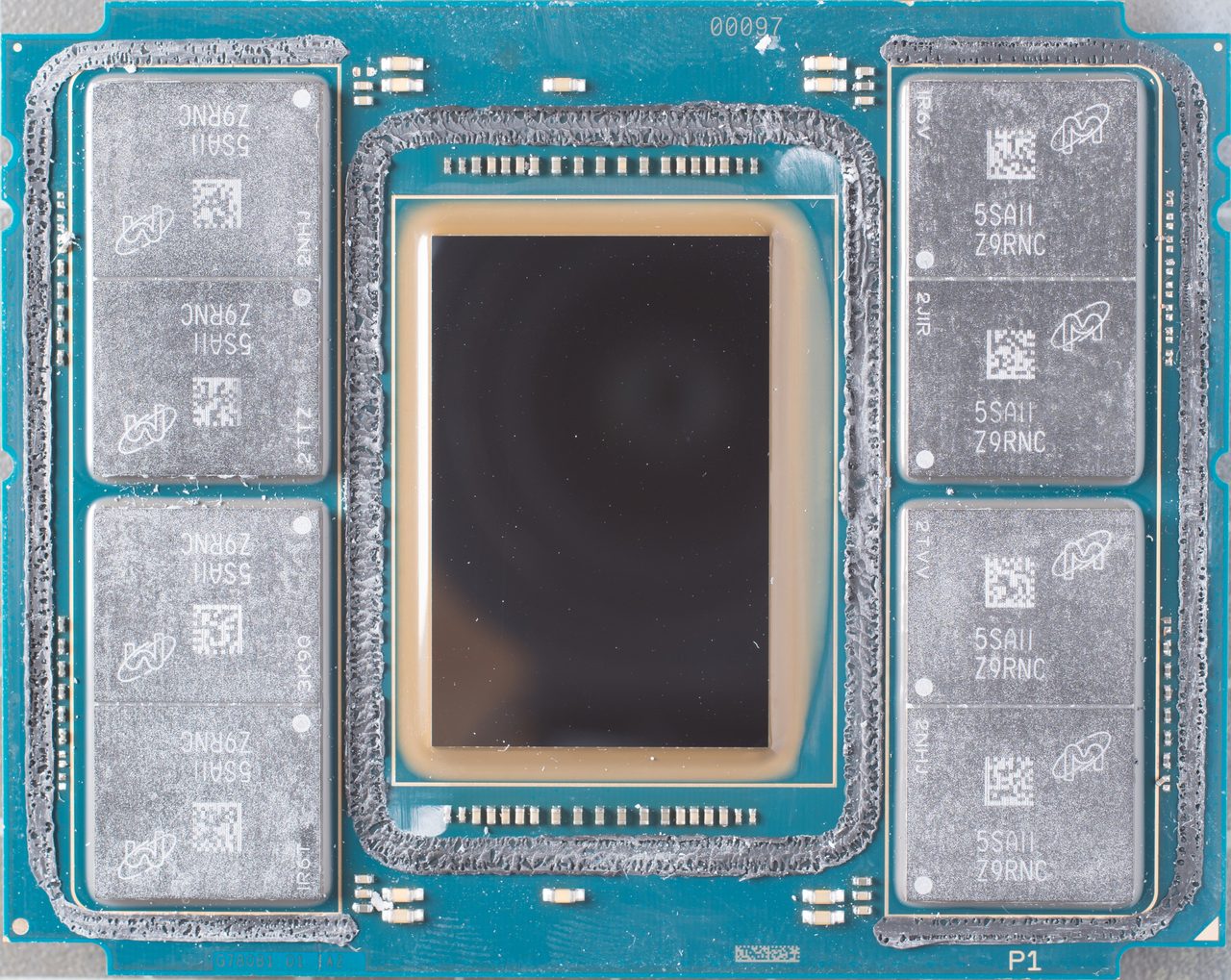
In November 2017 Intel hired Raja Koduri, who had run AMD's Radeon Technologies Group, and announced that it would build discrete GPUs again. The architecture was unveiled in December 2018 as Xe: one family of designs scaled from integrated graphics up to supercomputers. The low end came first, as the graphics of the Tiger Lake laptop processors in 2020 and a small discrete card, DG1. In March 2019 the US Department of Energy announced that Aurora, the exascale machine at Argonne National Laboratory, would be built on Intel's future data-centre Xe GPU, and in December 2019 Intel bought the Israeli AI-chip company Habana Labs for about $2 billion, which brought it the Gaudi accelerators. Part 26 follows both.
The gaming cards took longer. The first Arc graphics, the Alchemist generation, reached laptops in March 2022, desktops in China that June, and the rest of the world in October 2022 as the Arc A770 and A750, the better part of a year later than Intel had first promised. The hardware was reasonable for its price. The drivers were not. Older games written for DirectX 9 and 11, which Nvidia and AMD had spent twenty years tuning their drivers for, ran poorly or not at all, and the cards needed a motherboard feature called Resizable BAR to perform properly. Intel spent 2023 rewriting much of its driver, and performance in older games rose substantially, but the first impression stuck. Intel reorganised its graphics group in December 2022, and Koduri left in March 2023.
The second generation was better received. The Battlemage-based Arc B580 of December 2024, a $249 card with 12 GB of memory, was widely judged the best value in its class at launch, a rare moment of real praise for an Intel graphics card. Part 23 has the chips themselves.
Retrenchment (2024 to 2026)
By then Intel as a whole was in trouble. It lost about $19 billion in 2024, its chief executive, Pat Gelsinger, left in December, and his successor, Lip-Bu Tan, appointed in March 2025, set about cutting. The data-centre GPU plans were cut first. In January 2025 Intel said that Falcon Shores, the chip meant to merge its Xe GPUs and Gaudi accelerators, would not be sold and would serve only as an internal test chip. In September 2025 Nvidia invested $5 billion in Intel, and the two companies agreed to develop Intel PC processors with Nvidia RTX graphics chiplets inside them, which raised obvious questions about Intel's own graphics.
The questions have only partly been answered. Intel's integrated graphics carried on: the Panther Lake laptop processors of January 2026 have up to twelve Xe3 cores in their Arc B390 graphics. In February 2026 Intel announced an annual cadence for its GPU architectures, Xe3P in 2026 and its successor in 2027, aimed first at integrated graphics and at Crescent Island, an inference accelerator for data centres. The discrete gaming cards fared worse. The larger Battlemage chip that enthusiasts had waited two years for arrived in March 2026 only as a workstation card for AI, the Arc Pro B70, and in April 2026 a widely reported leak said the next generation's discrete gaming cards had been cancelled, with the generation after that undecided. An Intel executive told reporters at Computex in June that desktop GPUs remained super important to the company. By Jon Peddie Research's count Intel's share of add-in graphics cards in the first quarter of 2026 was about 1 per cent.
The whole run in one table
| Product | Year | What it was | What became of it |
|---|---|---|---|
| Intel740 | 1998 | a graphics card that kept its textures in main memory | overtaken within a year; Intel left discrete graphics |
| 810 chipset | 1999 | graphics built into the chipset | the start of two decades of integrated graphics |
| Sandy Bridge | 2011 | the GPU on the processor's own die, plus Quick Sync video | the arrangement every Intel PC processor still uses |
| Iris Pro | 2013 | 40 execution units and 128 MB of embedded DRAM as a cache | the most powerful integrated graphics of its time |
| Larrabee | 2006 to 2009 | dozens of x86 cores with 512-bit vector units, graphics in software | cancelled as a GPU; became Xeon Phi and AVX-512 |
| Xeon Phi | 2012 to 2020 | Larrabee's cores for supercomputers | powered the fastest supercomputer of 2013 to 2015, then ended |
| Arc A-series (Alchemist) | 2022 | Xe-HPG, 21.7 billion transistors in the A770 | decent hardware held back by drivers |
| Data Center GPU Max (Ponte Vecchio) | 2023 | 47 tiles, more than 100 billion transistors | built Aurora; its successors were cancelled |
| Gaudi 3 | 2024 | Habana's AI accelerator, not a GPU | missed its sales target; line folded into later plans |
| Arc B-series (Battlemage) | 2024 | Xe2, 19.6 billion transistors in the B580 | well received; the larger chip went only to workstations |
| Panther Lake | 2026 | up to twelve Xe3 cores in a laptop processor | shipping |
| Crescent Island | 2026 | an Xe3P inference card with 160 GB of LPDDR5X | due to sample to customers in the second half of 2026 |
What the history is telling you
Three things stand out beside the Nvidia and AMD histories.
The first is that Intel never lacked graphics expertise. It has designed more GPUs, shipped in more computers, than either rival, and the media engines, the compilers and the low-power designs are good. What it repeatedly lacked was the thing Part 16 found at the centre of Nvidia's success and Part 17 found missing at AMD for a decade: the patience to keep one programmable design and one software stack going, year after year, until developers trusted it. Intel's big-GPU efforts started and stopped, i740, Larrabee, Xeon Phi, Rialto Bridge, Falcon Shores, and each stop reset the clock on the drivers and the software that a GPU is judged by.
The second is the x86 instinct. Larrabee was the clearest test anyone has run of whether general-purpose cores, made wide enough, can do a GPU's job, and the answer was no: the machinery that makes a CPU core good at one thread is exactly what a GPU leaves out. When Intel came back with Xe, it built lanes, vector engines and thread schedulers like everyone else's, and Part 11 shows how much it then resembled them.
The third is where the lifeline was. AMD's graphics survived its lean years on console contracts, Part 17 found. Intel's survived on integrated graphics, which kept a large graphics team employed and a driver team busy whether or not there was a graphics card to sell. That is also why, in 2026, the future of Intel's GPUs looks most secure in the place it started, inside the processor, and least secure on a card of its own.
Next comes the factory. Intel is the one company in this series that owns leading-edge chip plants, yet nearly all of its recent GPU silicon, the Arc chips and Ponte Vecchio's compute tiles included, was made by TSMC, which says something about how hard the next part's subject is. It is also where the reticle limit and yield explain why every company in this series is now cutting its biggest designs into pieces.
Next: How a Chip Is Made: from sand to a wafer, the machine that prints with light, what a die is and how many fit, why an RTX 4090 has 128 working SMs out of 144, and how the memory ends up glued to the chip.