Part 21 took apart Nvidia's gaming chip and Part 22 AMD's. The third company to sell graphics cards in these years arrived in 2022 with no gaming card of its own for twenty-four years, as Part 18 told. Intel's Arc cards are the newcomer's version of the same machine, built from the Xe-cores of Part 11, and they are interesting partly for what they did well and partly for what they show about how much of a GPU is not the chip at all.
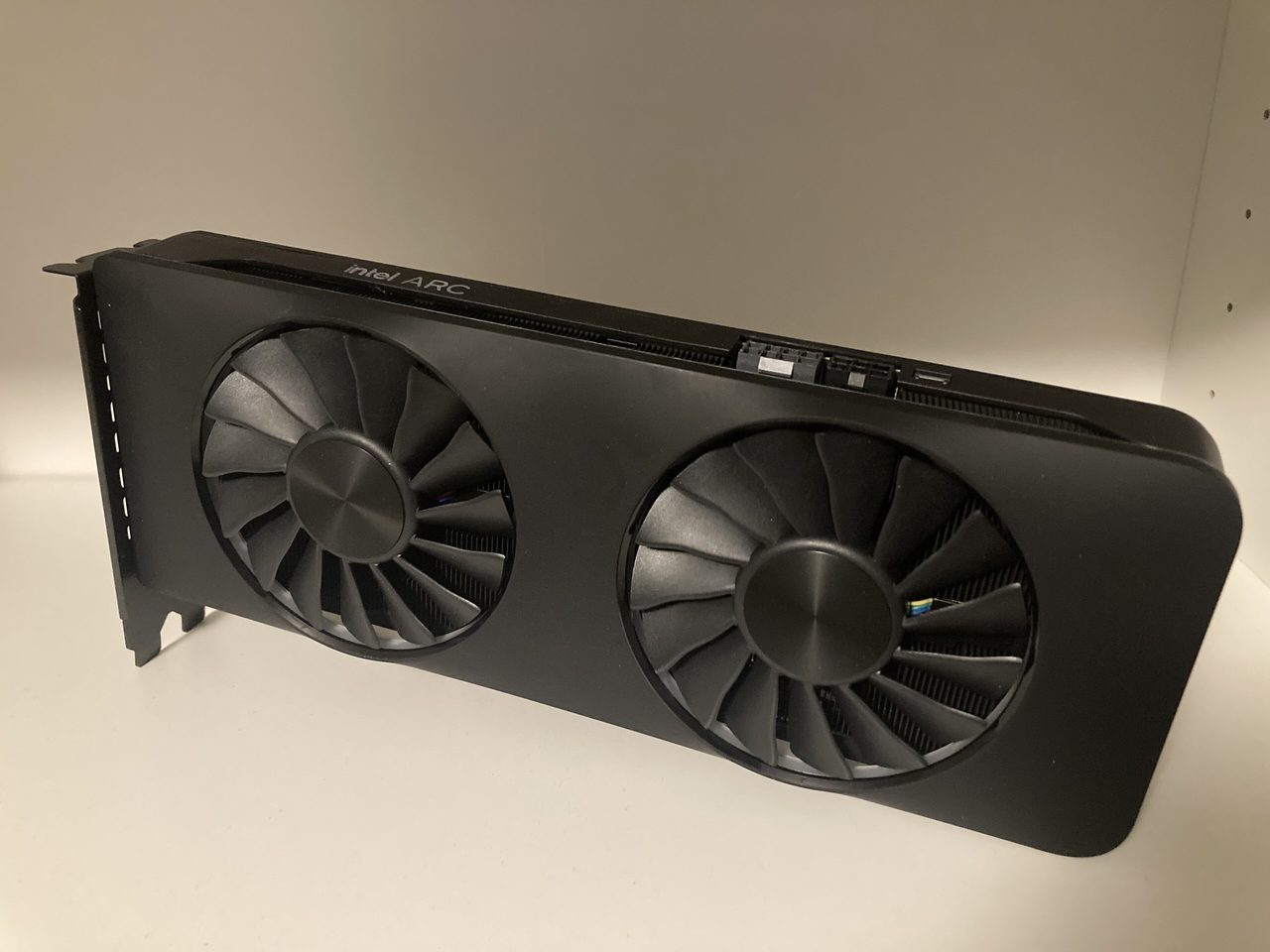
By the numbers
| Arc A770 (Alchemist) | Arc B580 (Battlemage) | RTX 4060 (Ada), for comparison | RX 7600 (RDNA 3), for comparison | |
|---|---|---|---|---|
| Launched | October 2022, $329 to $349 | December 2024, $249 | June 2023, $299 | May 2023, $269 |
| Chip | ACM-G10 | BMG-G21 | AD107 | Navi 33 |
| Transistors, area | 21.7 billion, 406 mm² | 19.6 billion, 272 mm² | 18.9 billion, 159 mm² | 13.3 billion, 204 mm² |
| Process | TSMC 6 nm | TSMC 5 nm | TSMC 4N | TSMC 6 nm |
| Building blocks | 32 Xe-cores | 20 Xe-cores | 24 SMs | 32 CUs |
| Lanes | 4,096 | 2,560 | 3,072 | 2,048 |
| Last-level cache | 16 MB L2 | 18 MB L2 | 24 MB L2 | 32 MB Infinity Cache |
| Memory | 16 GB GDDR6, 256-bit, 560 GB/s | 12 GB GDDR6, 192-bit, 456 GB/s | 8 GB GDDR6, 128-bit, 272 GB/s | 8 GB GDDR6, 128-bit, 288 GB/s |
| FP32 peak | 17.2 TFLOPS | 13.7 TFLOPS | 15.1 TFLOPS | 21.8 TFLOPS, with dual issue |
| Board power | 225 W | 190 W | 115 W | 165 W |
Read the area row first. The four cards competed for roughly the same buyers, and in games performed within a few tens of per cent of each other, yet Intel's chips were by far the largest: the A770's die is two and a half times the RTX 4060's, the B580's 70 per cent larger. Part of that is the process, a generation behind Nvidia's for Alchemist, and part is a newcomer's design that had not yet learned where to economise. Either way it is the commercial story of Arc in one line. Intel sold a lot of silicon at a low price, which made the cards good value for buyers and hard to make money on.
The memory row is the other thing to notice. At each price point Intel gave more memory, 16 GB on the A770 against 8 GB on its rivals, 12 GB on the B580, and a wider bus to go with it. That generosity is why Arc cards turned up in this series' calculations about running models at home, below.
Alchemist, and the driver problem
ACM-G10 was not a bad chip. Its 32 Xe-cores, hardware ray tracing, matrix engines and 16 GB of memory gave it, on paper, the specifications of a card a class above its price. In games written for recent graphics interfaces, DirectX 12 and Vulkan, it usually performed roughly where those specifications suggested.
The trouble was everything older. A graphics driver is a very large program that translates what a game asks for into what a particular GPU can do, and for games written for DirectX 9 and DirectX 11, which put much more of the work on the driver, Nvidia and AMD had twenty years of accumulated tuning, workarounds and fixes for individual games. Intel's driver had come from integrated graphics, where nobody had expected high performance in demanding games. At launch some older titles ran at a fraction of the speed of newer ones, some not at all, and Intel's own initial approach to DirectX 9 was to translate it into DirectX 12 rather than support it natively. The cards also needed a motherboard feature called Resizable BAR, which lets the processor map the card's whole memory at once instead of through a small window, and without it performance fell sharply; older PCs did not have it.
Intel spent the following year rewriting much of the driver, and the gains in older games were large, in some cases nearly doubling the frame rate. But Alchemist became the clearest demonstration in this series of a point Part 14 made about CUDA: the hardware is the part a newcomer can buy, and the software is the part that takes decades.
Ray tracing, sorted
Where Alchemist was strong was ray tracing, and the way Intel built it is a useful third design beside the two of Part 22. That part's diagram split tracing a ray into walking the tree of boxes and testing the boxes and triangles. AMD's RDNA 2 and 3 did the tests in hardware and the walk in shader code; Nvidia's RT cores do both in hardware. Intel's ray tracing unit, one per Xe-core, also does both in hardware, as Nvidia's does. Battlemage's version has three traversal pipelines walking rays through the tree at once, can do eighteen box tests and two triangle tests per clock, and keeps 16 KB of the tree in a cache of its own.
What Intel added was a unit for the step after. When a group of rays has found what it hit, each ray needs a shader run for the material at that point, a reflective floor, a rough wall, a leaf, and the rays in a group usually hit different materials. Run as they are, that is Part 9's divergence at its worst: the hardware thread runs the floor's shader with only the floor's rays switched on, then the wall's, then the leaf's. Intel's thread sorting unit regroups the rays before shading, collecting rays that hit the same material into the same hardware thread, so that each thread runs one shader with most of its lanes busy. Nvidia added the same idea to Ada in the same year under the name Shader Execution Reordering, which Part 21 described.
The combination gave Alchemist ray-tracing performance that, relative to its performance in ordinary rendering, held up better than AMD's RDNA 2 and RDNA 3 did. It is the same lesson Part 22 drew from AMD's choices, approached from the other side: tree walking and divergent shading are the expensive parts of ray tracing, and the designs that spend silicon on exactly those do best.
Battlemage: more from less
The second generation fixed most of what the first got wrong and kept what it got right. BMG-G21, the chip in the Arc B580 of December 2024, has 20 Xe2 cores where ACM-G10 had 32, on a die two-thirds the size, and is faster than the A770 in most games. Part 11 described the core: eight vector engines of sixteen lanes instead of sixteen of eight, fewer and wider, which Intel said gave about 70 per cent more performance per Xe-core, along with higher clocks and the better ray-tracing unit above. The geometry hardware that feeds triangles into the pipeline of Part 20 was rebuilt and much faster, a weakness of Alchemist in some games.
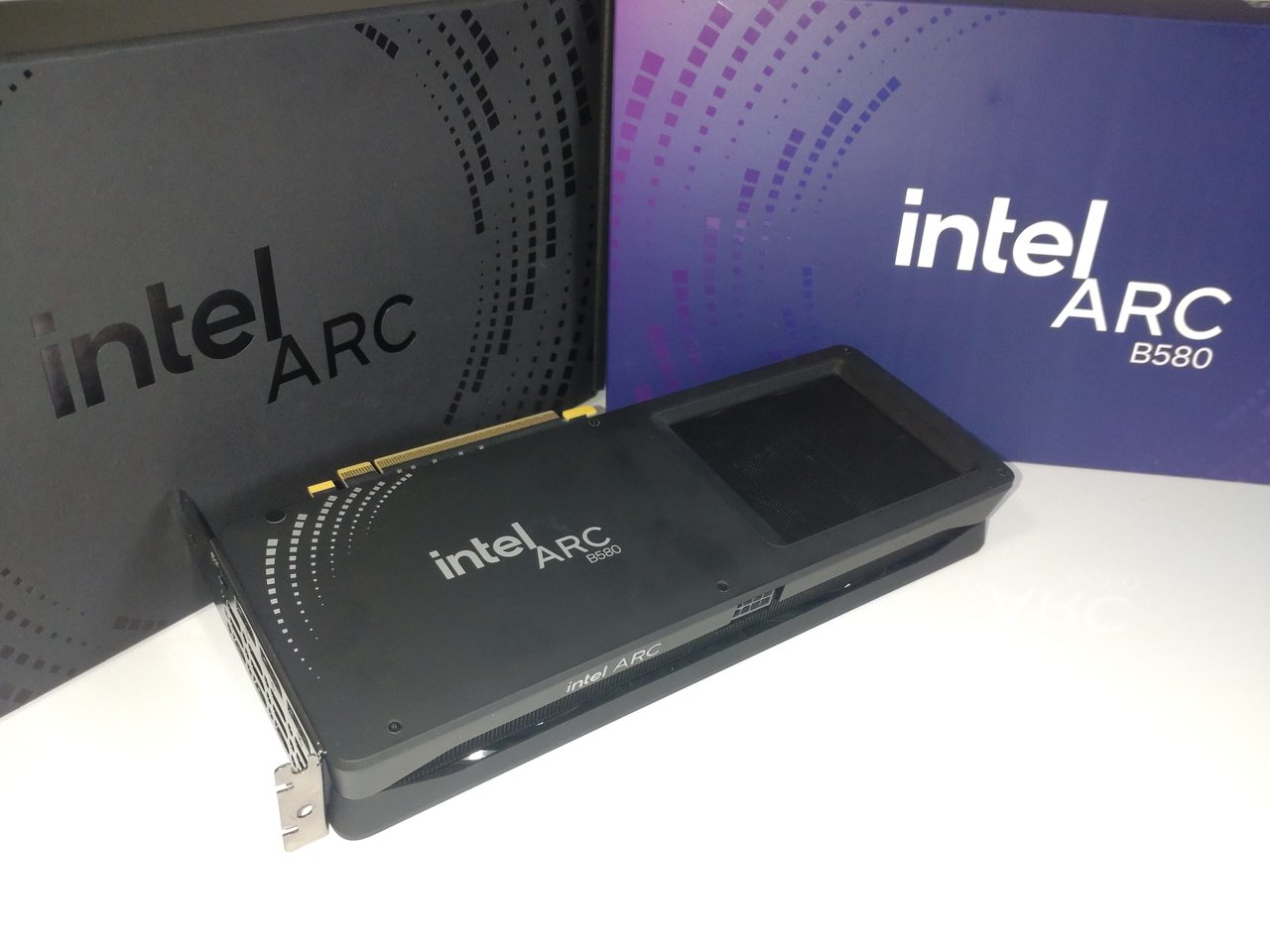
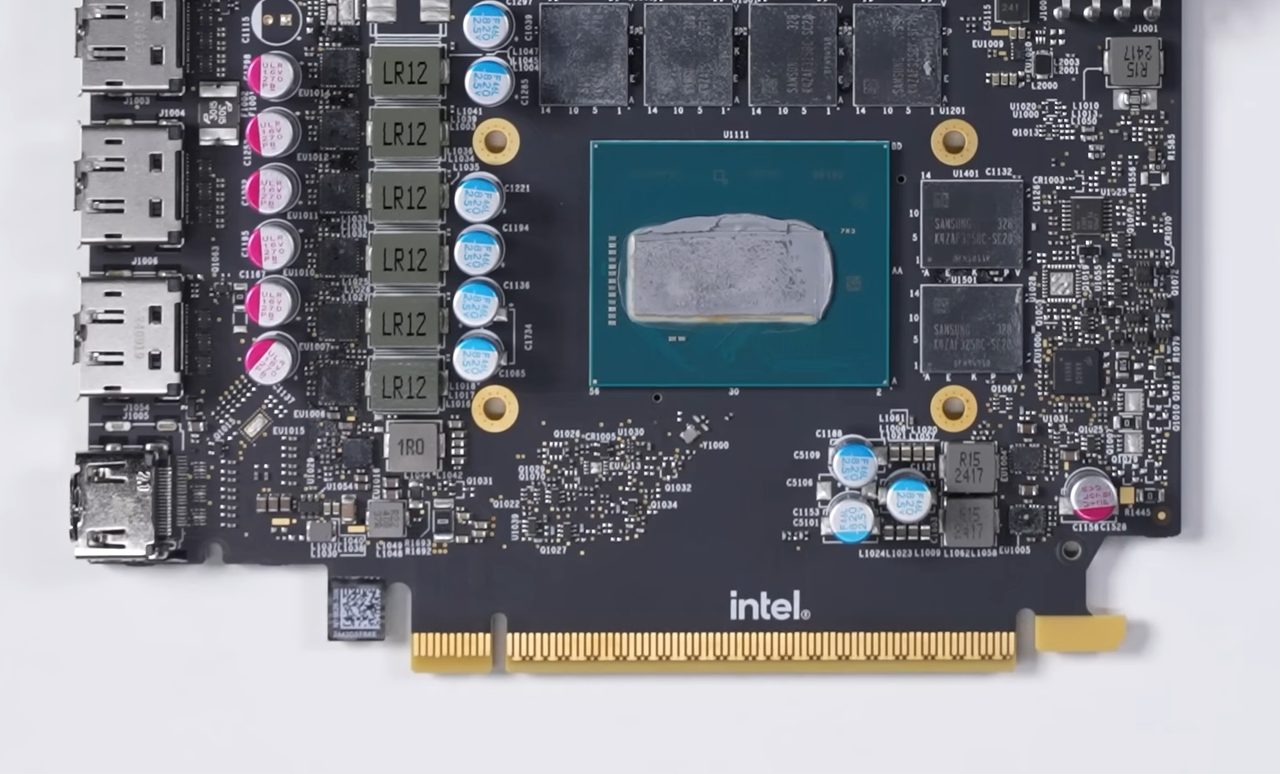
At $249 with 12 GB, the B580 was received as the best-value card of its class: in reviewers' tests at launch it matched or somewhat beat Nvidia's RTX 4060, which cost $50 more and had 8 GB. The drivers were in much better shape. One problem surfaced in January 2025, when testers found that the B580 lost far more performance than its rivals when paired with an older, slower processor, because its driver needed more of the processor's time to prepare each frame. It is a small, telling detail. Even on a good chip, the driver's efficiency on the CPU side is part of the GPU's performance, and it is exactly the kind of thing two decades of tuning had polished in Nvidia's and AMD's drivers.
Matrix engines and media engines
Arc's XMX engines do for Intel what tensor cores do for Nvidia's gaming cards. Intel's upscaler, XeSS, launched with Alchemist in 2022, renders each frame at a lower resolution and uses a neural network on the XMX engines to reconstruct the rest, with a slower fallback for other companies' cards that runs on ordinary integer instructions. XeSS 2, which arrived with Battlemage, added frame generation and a mode to cut input latency, the same list of features as DLSS 3 and FSR, reached a year or two later. The B580's matrix engines are rated by Intel at up to 233 trillion 8-bit integer operations a second.
The other piece of fixed-function hardware worth a mention is the media engine, Intel's oldest graphics speciality since the Quick Sync encoders of 2011. The Arc A380 of June 2022 was the first graphics card of any brand to encode video in the AV1 format in hardware, months ahead of Nvidia's and AMD's next generations, and Arc cards have been popular since with people who stream or transcode video, for whom the media engine matters more than the frame rate.
Arc in laptops
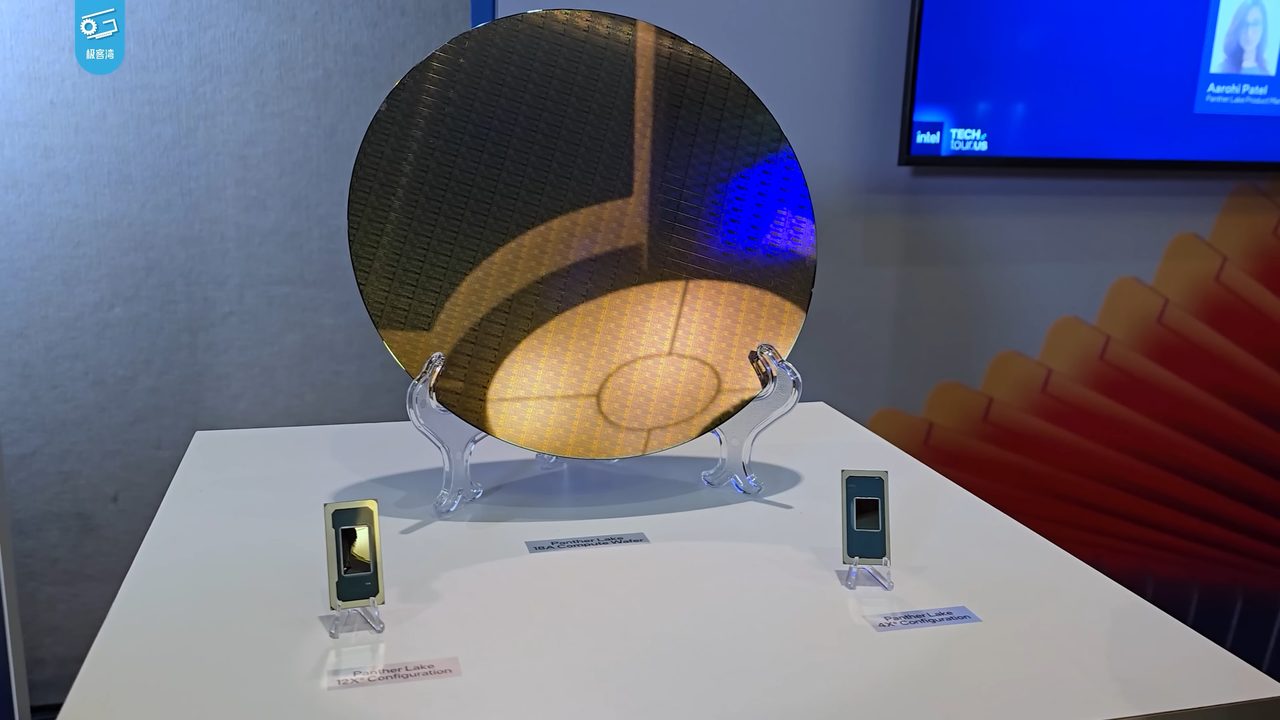
Most Arc graphics are not on cards, in the same way that most RDNA chips are in consoles. Intel's laptop processors have used Xe graphics since 2020, and from 2023 their graphics carry the Arc name. The Meteor Lake processors of December 2023 had up to eight Xe-cores, the Lunar Lake processors of 2024 eight of the newer Xe2 kind, pictured in Part 11, and the Panther Lake processors launched in January 2026, Intel's Core Ultra Series 3, up to twelve Xe3 cores in a configuration called Arc B390. Intel claimed that it ran games on average 73 per cent faster than the graphics in AMD's comparable laptop chips, a comparison with AMD's mainstream Strix Point rather than its much larger Strix Halo of Part 22, but a large step either way for graphics that share a laptop processor's power budget.
Arc as a home AI machine
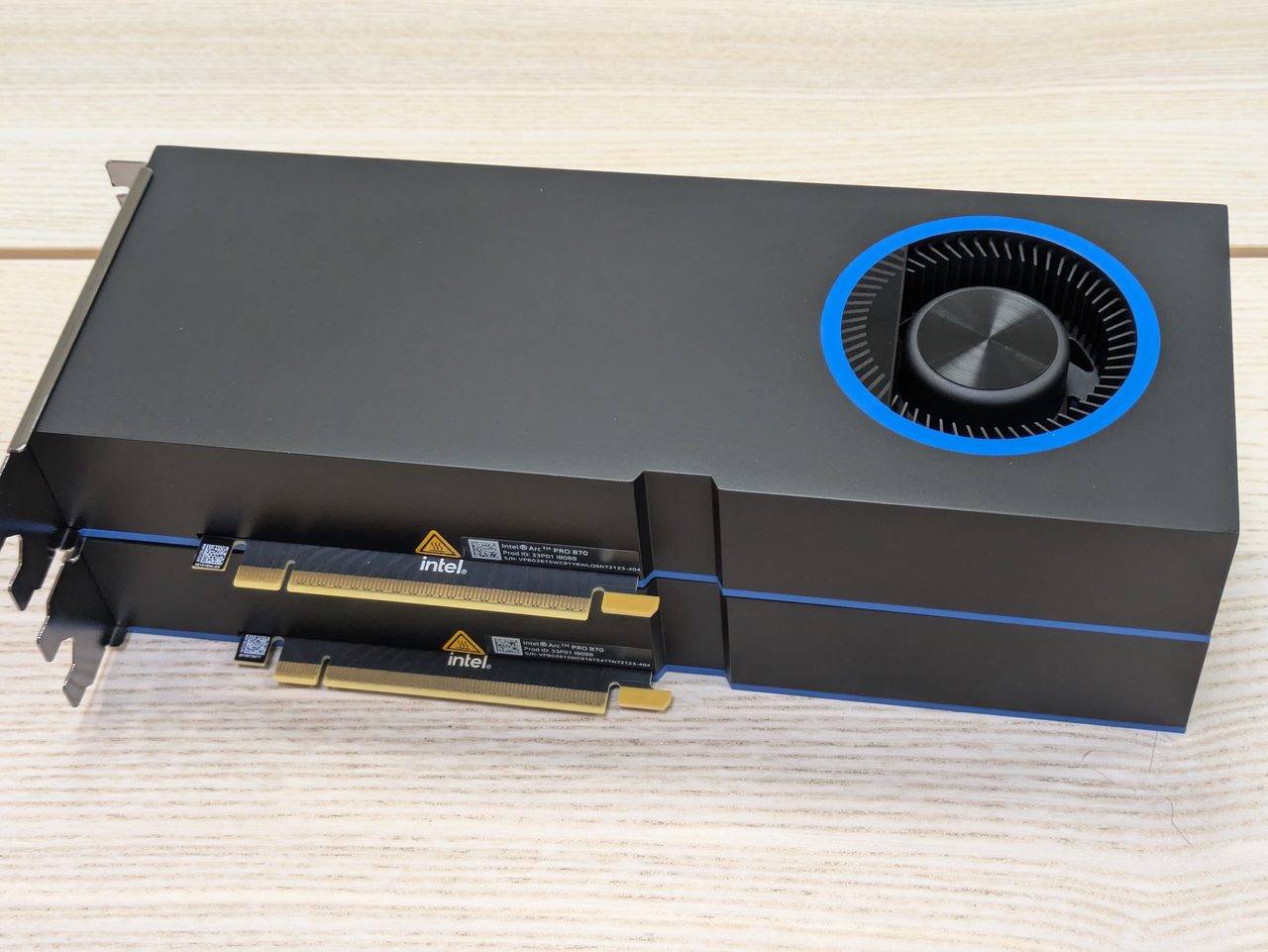
Run Part 21's arithmetic once more. Generating text is limited by memory bandwidth, so a card's ceiling is its bandwidth divided by the bytes of weights it reads per token, and its capacity decides what fits at all. The B580's 12 GB at 456 GB/s holds a 14-billion-parameter model at 4 bits, about 8 GB, with an upper bound of around 55 tokens a second, more than any 8 GB card at its price could hold. Intel then leaned into this. The Arc Pro B60 of 2025 put 24 GB on the same chip, and board makers built cards carrying two of them, 48 GB in one slot. In March 2026 the larger Battlemage chip, BMG-G31, with 32 Xe-cores, finally appeared, not as the gaming card enthusiasts had hoped for but as the Arc Pro B70: 32 GB at 608 GB/s for $949, aimed squarely at running models locally. A 30-billion-parameter model at 4 bits, about 18 GB, fits with room for a long conversation, with a ceiling of about 34 tokens a second.
As with AMD's Radeons, the hardware was often ahead of the software. Intel's AI software, OpenVINO, its IPEX-LLM libraries and native support in PyTorch from 2024, made Arc cards usable for local models, but a newcomer to the field found far fewer ready-made recipes than for Nvidia's cards. The memory-per-dollar was what drew people in regardless.
What comes after Battlemage
As I write in October 2026, Intel has announced no gaming graphics card to follow the B580. Its stated plan, from February 2026, is a new GPU architecture every year, Xe3P in 2026 and its successor in 2027, but the products named for Xe3P are integrated graphics in the next generation of laptop and desktop processors and the Crescent Island data-centre card of Part 26. In April 2026 a widely reported leak said that Intel had cancelled the discrete gaming cards of the Xe3 generation and had not decided on the one after. In June an Intel executive told reporters at Computex that desktop graphics remained super important to the company, without naming a product. And Intel's agreement with Nvidia in September 2025 includes PC processors with Nvidia graphics chiplets inside, which raises the question of how much of the graphics in Intel's own high-end PC chips will remain Intel's.
Where this leaves us
Arc is the story of a newcomer building a competitive GPU in a few years and finding that the GPU was the easier part. Its hardware choices were often good, sometimes ahead of the field: ray tracing done fully in hardware with a unit to sort the shading, the first AV1 encoder, matrix engines and an upscaler from the first generation, and more memory than its rivals at every price. Its weaknesses were silicon efficiency, large dies sold cheaply, and above all software, drivers that took years to catch up with twenty years of competitors' tuning. Battlemage closed much of both gaps. Whether Intel keeps making graphics cards to benefit from that is, in 2026, an open question. Its graphics in laptops, where Intel has always been strongest, are better than they have ever been.
The other thing Ada was the gaming half of was Hopper, the data-centre chip, and both AMD and Intel built answers to it. Hopper first.
Next: Hopper: the H100, 80 billion transistors spent entirely differently from Ada's 76, HBM3, the Transformer Engine, and the features that let SMs cooperate with each other for the first time.