Part 1 ended with a switch that electricity can flip, the relay, and with the two things it could not do: flip fast, and make a weak signal strong. Both of those are the vacuum tube's story. Go back to the microwave oven from the opening of Part 1. The magnetron behind its back wall is the great-grandchild of a device found by accident in 1883, inside a light bulb, by a man who patented it and then put it in a drawer. This part builds that device up a piece at a time, follows it through the first computers, and ends where the series really begins, with the transistor.
The vacuum tube: from light bulb to one-way valve
The device that made electronics possible was found by accident, inside a light bulb, and the quickest way to understand it is to build it up a piece at a time: first the bulb, then a plate, and, in the next section but one, the part that changed everything.
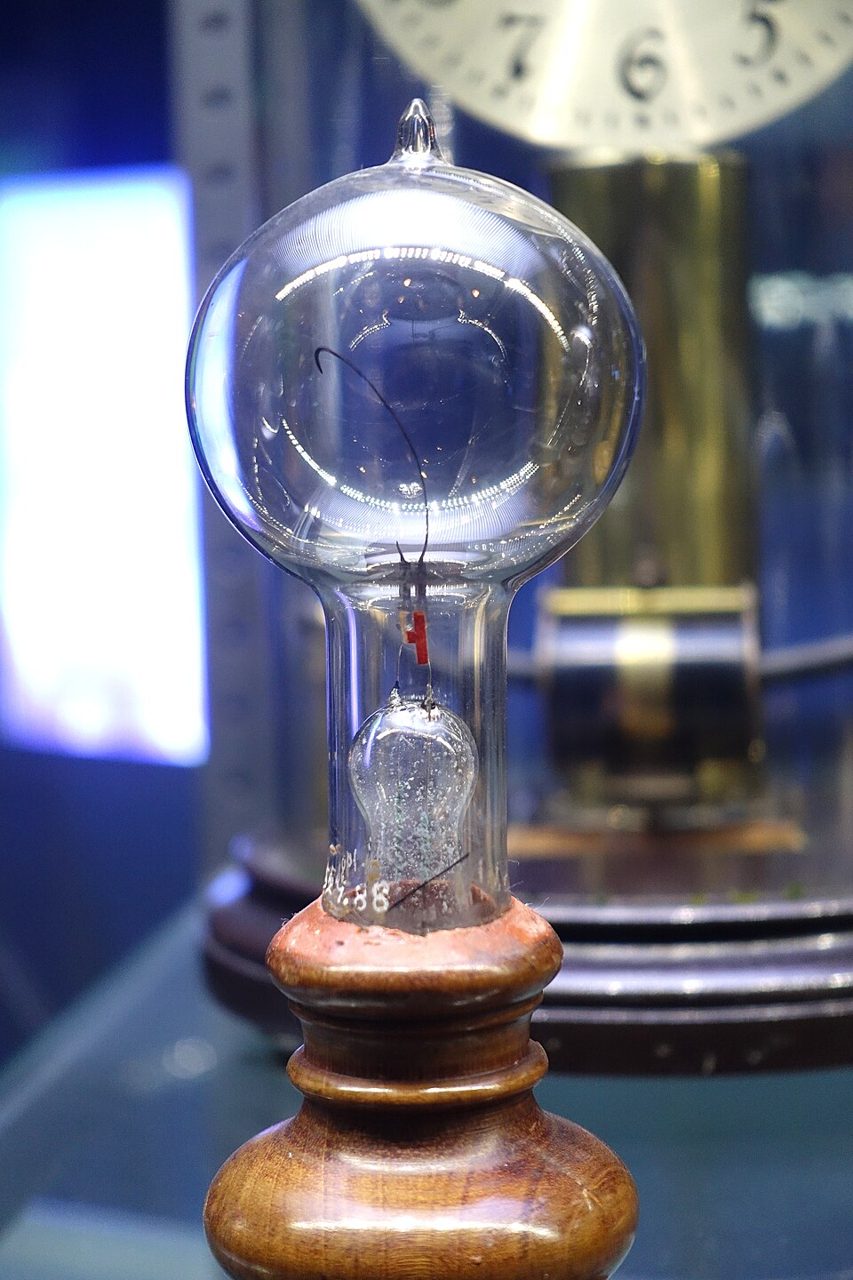
Start with the bulb itself. Thomas Edison's lamp of 1879 is a thin filament inside a glass envelope with the air pumped out. The filament is heated white-hot by the current through it, and the vacuum is there because a filament that hot would burn away in seconds if there were any oxygen to burn in. Around 1883 Edison noticed something odd. If he put a second, separate piece of metal inside the bulb, a current would flow across the empty space from the hot filament to that plate, but only when the plate was connected to the positive side of the battery, and never the other way round. He patented the effect and did nothing with it.
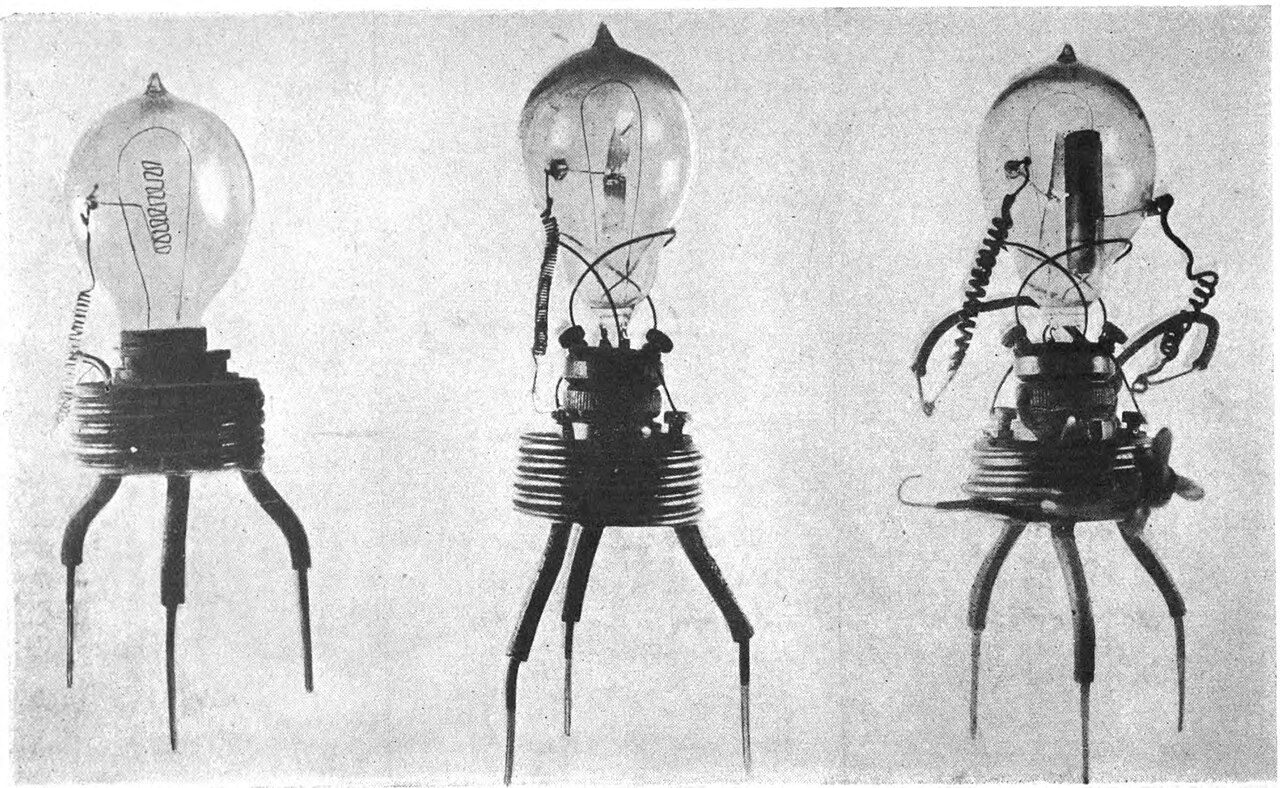
Here is what was happening. Heat the filament enough and it boils off electrons into the vacuum, a cloud of them hovering around the wire. Make the plate positive and it attracts the cloud: electrons stream across the gap and a current flows. Make the plate negative and it repels them, and since the cold plate emits no electrons of its own, nothing can flow back. Current goes one way only. In 1904 John Ambrose Fleming, who had worked for Edison, turned this into a component, the diode (two electrodes), a one-way valve for electricity, which is why British engineers call every tube a valve to this day.
Why a one-way valve matters
It is fair to ask what a component that only lets current through one way is for, and the answer is two things without which there would be no radio, no television, and no plug-in electronics of any kind.
The first is turning mains electricity into something a circuit can use. The power in your walls is alternating current: it reverses direction fifty or sixty times a second, because that is the easiest kind to generate and to send over long distances. A heater or a light bulb does not care which way the current goes. But an amplifier, and every circuit in this series, needs a steady push in one direction, direct current, the way a battery gives. Put a diode in the path and it passes the forward half of every cycle and blocks the reverse half, leaving a series of one-way pulses. Add a capacitor, the small tank from Part 1's side note, to fill in the gaps between the pulses, and the result is a nearly steady supply. This is rectification, and every radio, television, and amplifier that ever plugged into a wall had a rectifier tube at the back. The rectifier is still there in everything you plug in today, as a semiconductor diode the size of a grain of rice, and it is the first thing the current meets inside a phone charger.
The second job is picking a voice out of the air, and it deserves a careful look, because the trick sounds like it should not work. A radio receiver ends up throwing away half of the wave it receives. How does the music survive that?
The answer is that the music is not the wave. A station broadcasts a carrier: a wave that alternates far too fast to hear, around a million times a second for an AM station, and on its own carries no sound at all. To put the music on it, the transmitter makes the carrier's height rise and fall in step with the sound, a few hundred to a few thousand times a second, slow compared to the carrier's own wiggle. The scheme is called amplitude modulation, which is what the AM on a radio dial stands for, and the music lives entirely in the outline of the wave, its envelope, not in the wiggles themselves. Row 3 below is the picture to stare at.
Now the receiver's problem. Feed that wave straight to an earphone and nothing happens: every upward push is matched a millionth of a second later by an equal downward pull, the average is zero, and no earphone can move a million times a second anyway. The signal is there, but it is folded up symmetrically, top mirroring bottom. This is where the one-way valve earns its keep. Pass the wave through a diode and the bottom half is simply blocked. The symmetry is broken, the pushes no longer cancel, and the average of what remains rises and falls exactly as the envelope does, which is to say exactly as the music does. A capacitor then smooths away the leftover million-a-second bumps, the way it smoothed the rectifier's pulses, and what is left is row 1 again: the sound, recovered.
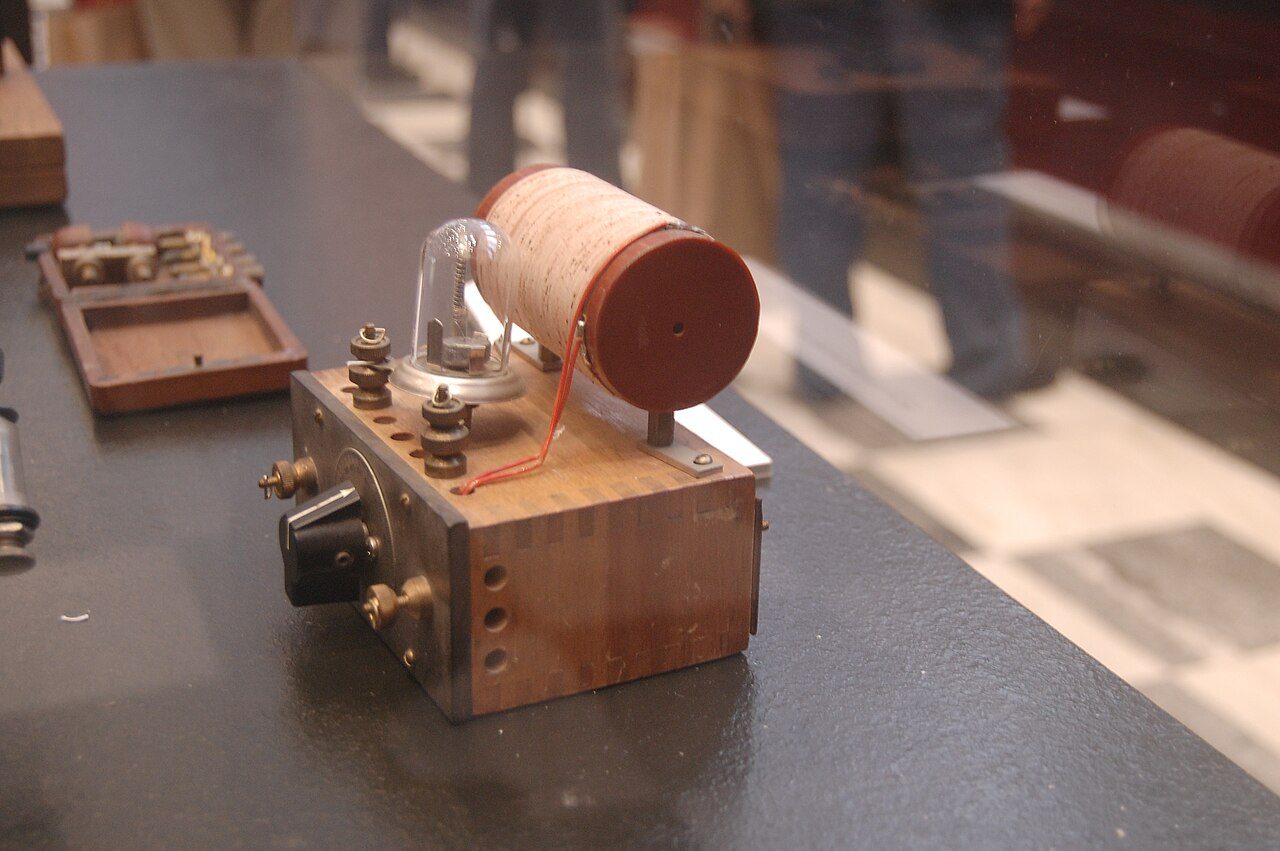
That is detection, and it is how every early radio worked. The crystal set that a child could build in the 1920s, a coil, a crystal, and an earphone, needed no battery at all: the diode was a "cat's whisker", a fine wire touching a crystal of galena, which happens to conduct one way, a semiconductor diode in use fifty years before anyone understood why it worked. The energy that moved the earphone came from the radio wave itself. What the crystal set could not do was make the sound any louder than the wave provided, and that is the cliffhanger the next section resolves.
The grid, and the first amplifier
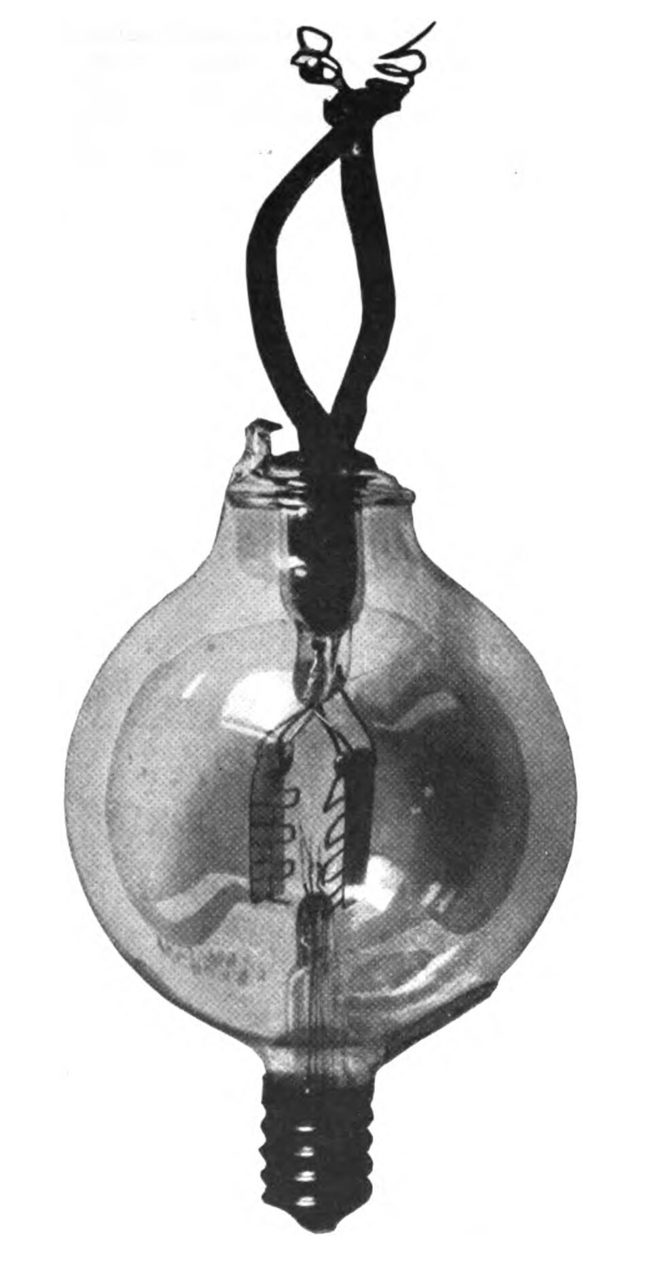
The diode is a valve with no handle. In 1906 Lee de Forest gave it one. He put a third element between the filament and the plate, a mesh of fine wire he called the grid, and found that a small voltage on the grid controlled the large current from filament to plate. Make the grid slightly negative and it repels the electrons, choking the stream. Make it less negative and the stream flows freely. And because the grid is a sparse mesh that the electrons fly through rather than land on, it draws almost no current itself: it governs the stream by electric influence alone. The device is the triode (three electrodes), and it is the ancestor of every transistor in your graphics card.
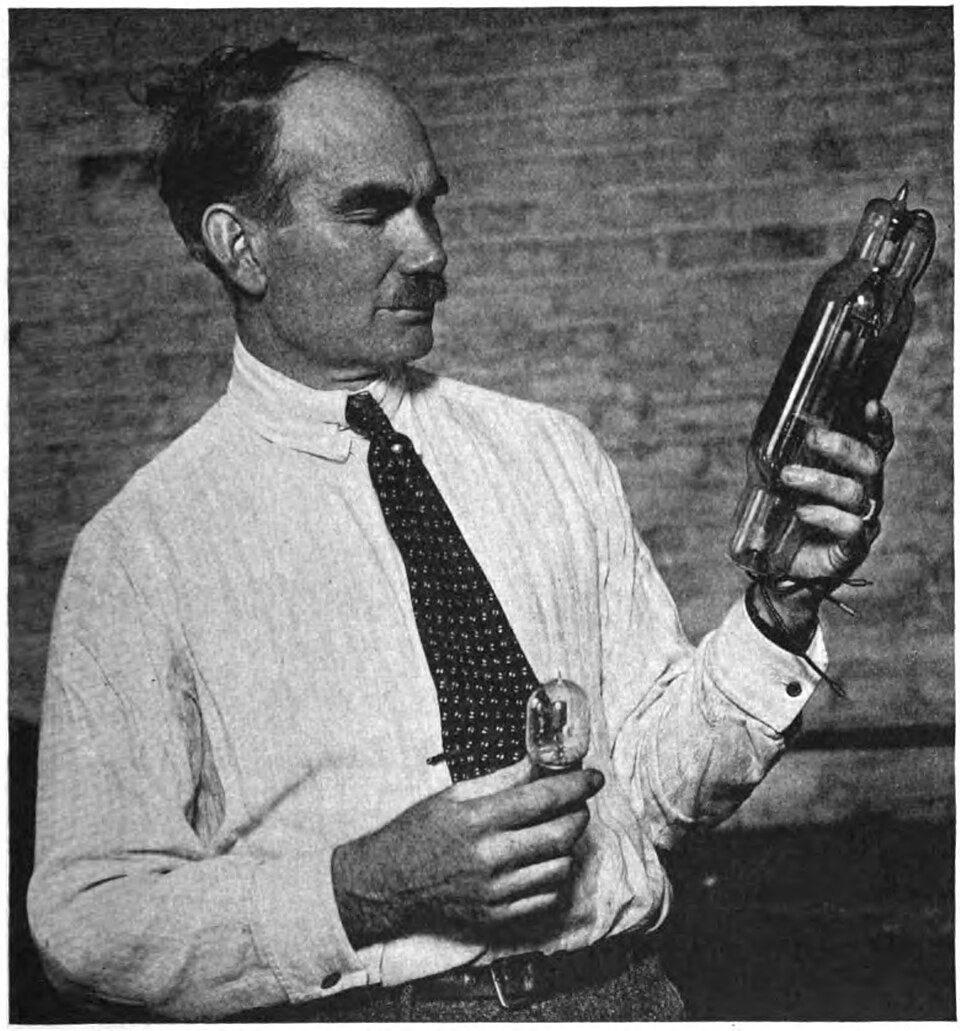
It is worth walking through what the triode actually does in a circuit, because "the first amplifier" is an idea the rest of electronics is built on, and one detail of it puzzles everyone at first: if the signal coming in is feeble, where does the loud version's energy come from?
Here is the arrangement. The grid is connected to the source of the weak signal, a microphone, an aerial, the worn-out voice arriving down a long telephone line. The plate is connected, through whatever should receive the loud version, a loudspeaker or the next stretch of line, to a hefty battery or power supply. The battery would happily drive a large current through the tube all the time. The grid stands in the way, throttling that current, and as the weak signal wiggles the grid's voltage by hundredths of a volt, the throttle opens and closes by the same rhythm. The plate current becomes a copy of the input's shape, drawn at the battery's strength.
So the amplifier does not make the small signal bigger, not really. It uses the small signal to sculpt a big current that was there for the taking, the way the garden tap's handle sculpts the mains pressure rather than pushing the water itself. The energy in the loud output is the battery's. The information in it is the whisper's. That is why the crystal set of the last section was doomed to be quiet, with no battery there was nothing to sculpt, and it is why the triode changed everything at once: add a battery and one tube, and any signal too faint to use became the same signal, usable. Chain a second tube after the first and it amplifies the amplified copy, which is how three repeater stations could carry a voice across a continent in 1915, each one re-sculpting a fresh battery's current into the arriving signal's shape.
One more thing falls out for free, and it is the reason this series cares. Wiggle the grid gently and the triode is an amplifier. Slam the grid between two extremes instead, hard negative and the stream is choked entirely, up to zero and it floods, and the triode is a switch, the relay's job with no moving parts and no millisecond of travel. Same tube, different manners. The garden tap is the analogy that carries this whole series: the handle is the grid, the water is the electron stream, and turning the handle moves no water itself. Hold onto that picture, because Part 3 uses exactly the same tap to explain the transistor, and the point of the whole story is that the tap stayed the same while everything around it changed.
What the tube made possible
The triode changed the world faster than any component before or since. In 1915 it let a telephone call cross the American continent for the first time, with three tube repeaters along the way, at Pittsburgh, Omaha, and Salt Lake City, restoring a voice that thousands of miles of copper had worn down to almost nothing. From 1920 it made radio broadcasting possible, both the transmitters and the sets in living rooms. It made television, radar, the electric guitar, sound in cinemas, and long-distance telephony. And because it could switch in a microsecond where a relay took a millisecond, it made the electronic computer: the AND and OR of Part 1, with a tube's grid in place of a relay's coil and its plate current in place of the contacts, a thousand times faster.
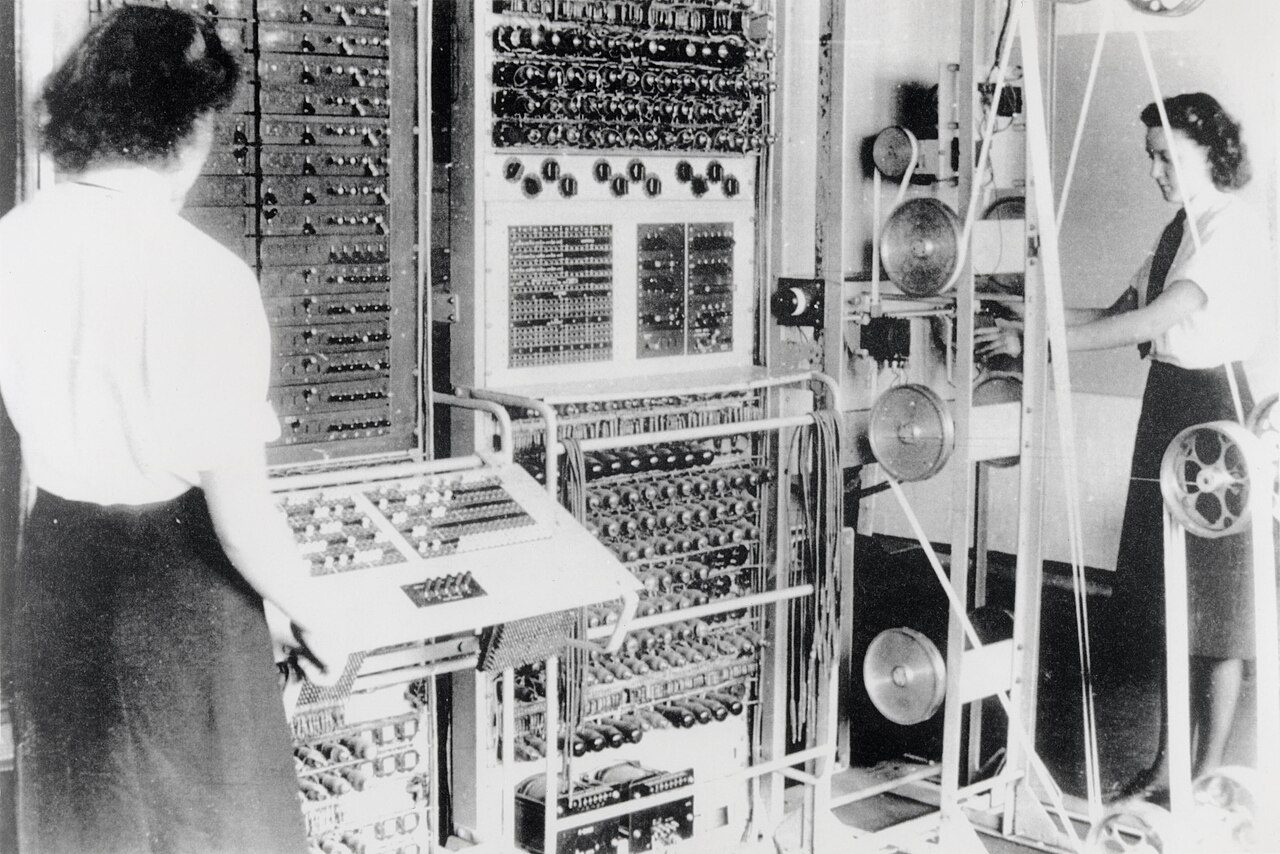
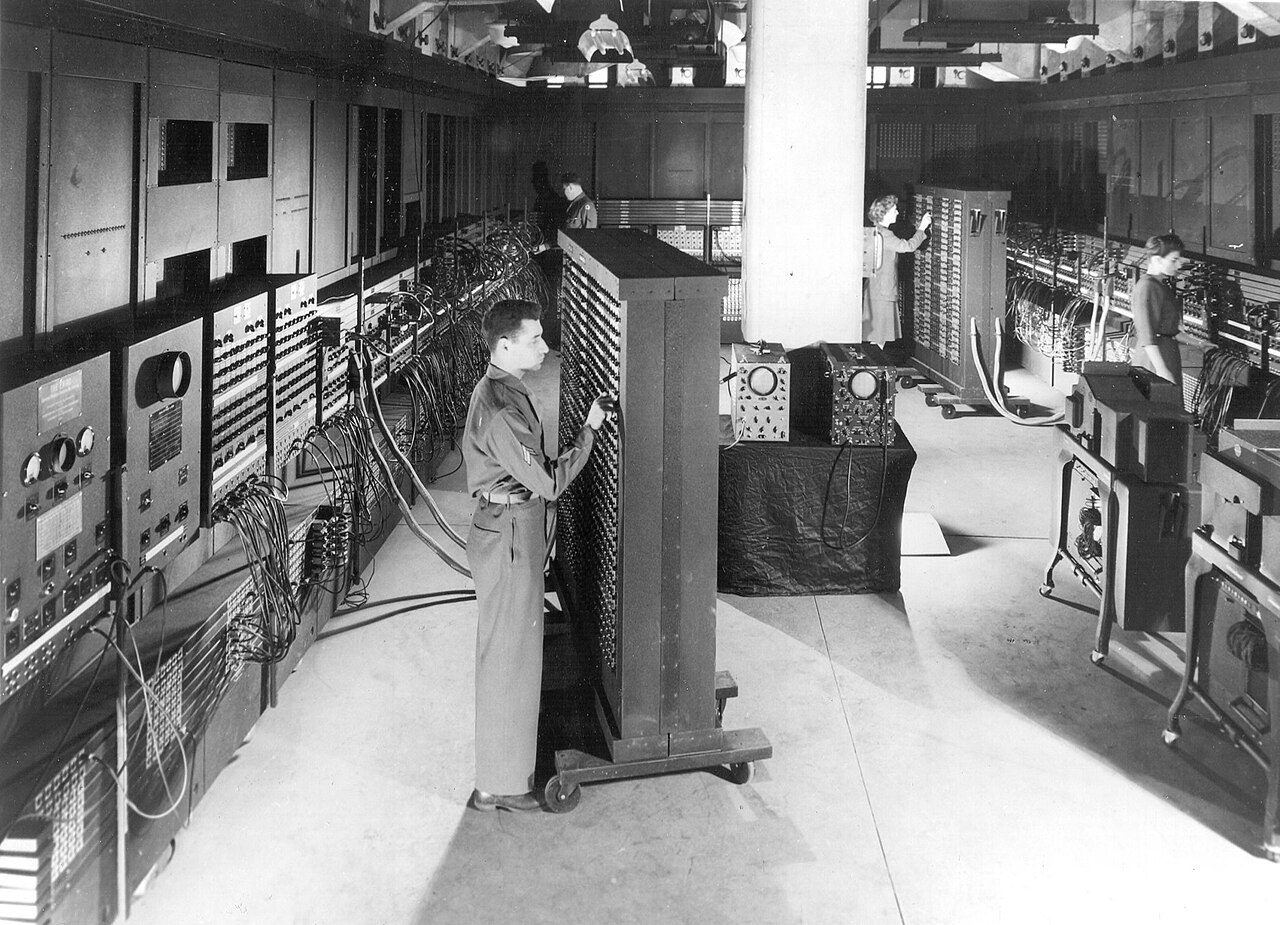
Colossus, the British code-breaking machine of 1943, used 1,600 tubes in its first version and 2,400 in its second. ENIAC, completed in 1945 in Pennsylvania, used 17,468 of them, could do 5,000 additions a second, filled a room of about 170 square metres, and drew 150 kilowatts. Nearly every computer of the 1950s was a tube computer: UNIVAC, the IBM 700 series, the early Manchester machines. The largest of them all was the SAGE air defence system, which went into service in 1958 with around 50,000 tubes per computer, two computers per site, and a power bill of three megawatts for the site. It was the biggest computer ever built, by most measures it still is, and it was obsolete before it was finished, for reasons the next section explains.
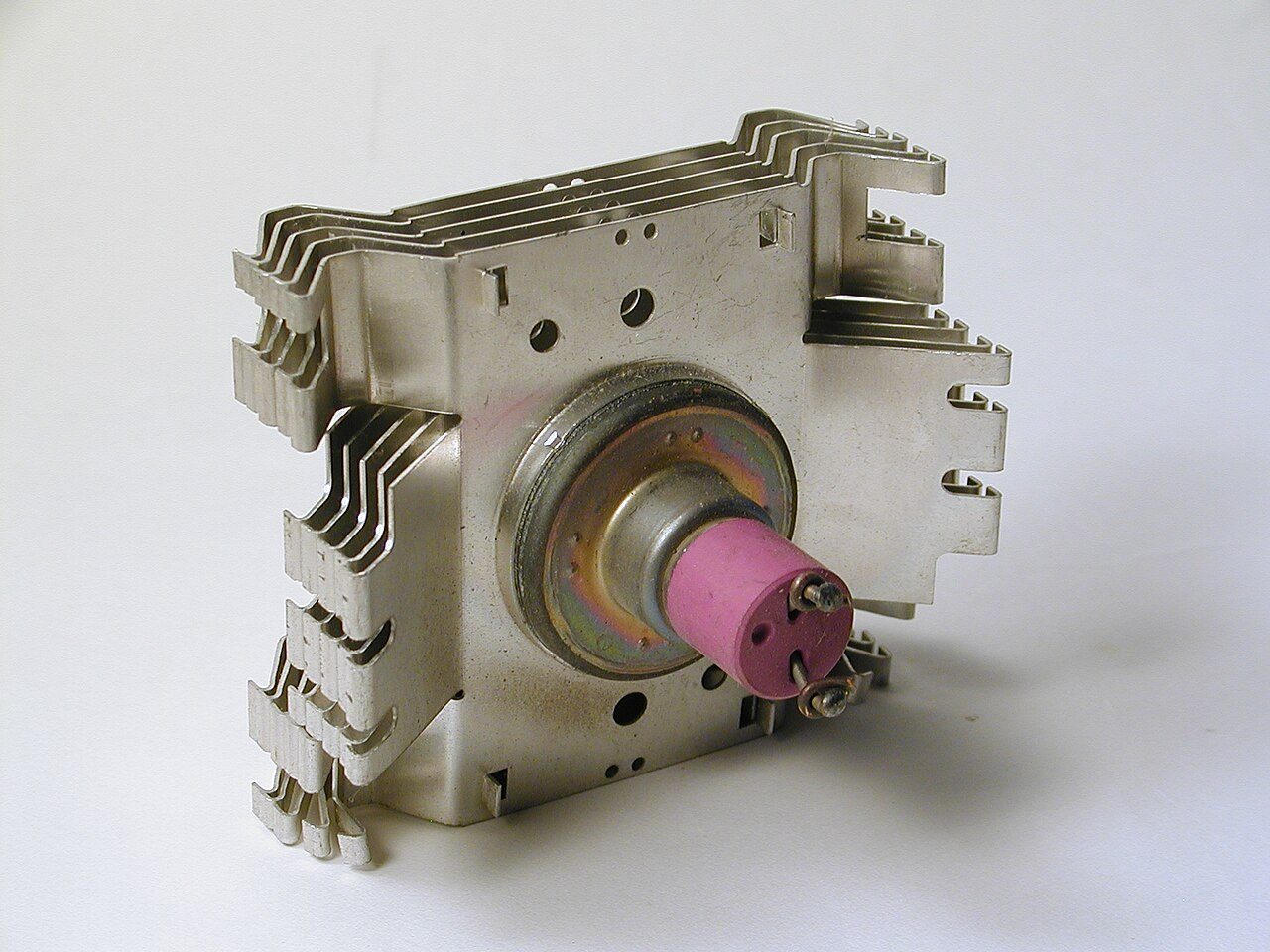
The tube also never went away, and this is the part people miss. It survived wherever the job was too hot, too powerful, or too high in frequency for a semiconductor to do cheaply. The magnetron in your microwave is a tube. The X-ray tube in a hospital CT scanner, a dentist's surgery, and an airport baggage scanner is a tube, pumping electrons into a metal target at a hundred kilovolts. Communications satellites amplify their downlink with travelling-wave tubes, because for decades nothing else could produce that power at those frequencies with that efficiency in orbit, and many still do. Broadcast radio and television transmitters ran on tubes the size of dustbins into the 2000s. Particle accelerators drive their beams with klystrons, tubes the size of a person. The fluorescent display on an older microwave clock or car dashboard is a small vacuum tube. And a large share of guitar amplifiers, and a smaller share of expensive audio equipment, still use tubes on purpose, because the way a tube distorts when overdriven is the sound of rock music, and no transistor circuit quite copies it. If you own a Fender or a Marshall, you own a handful of triodes that would be recognisable to de Forest.
What was wrong with it
Everything that was wrong with the tube followed from one fact: to boil electrons off the cathode, you have to heat it. A typical small tube burns a couple of watts in its heater alone before it does any work, and the largest single item in ENIAC's 150 kilowatts was the heaters, with a ventilation system to match. A tube takes half a minute to warm up before it works at all, which is why old radios and televisions came on slowly. And the heater, like the filament in a light bulb, eventually burns out. A good tube lasts a few thousand hours. That is fine for a radio with five tubes. It is a catastrophe for a computer with seventeen thousand, because with that many, one of them is always about to fail. ENIAC's engineers ran the heaters below their rated voltage and never switched the machine off, and still lost a tube every couple of days, each failure meaning a hunt through the racks. SAGE used tubes specially built for reliability and still needed a full-time crew replacing them.
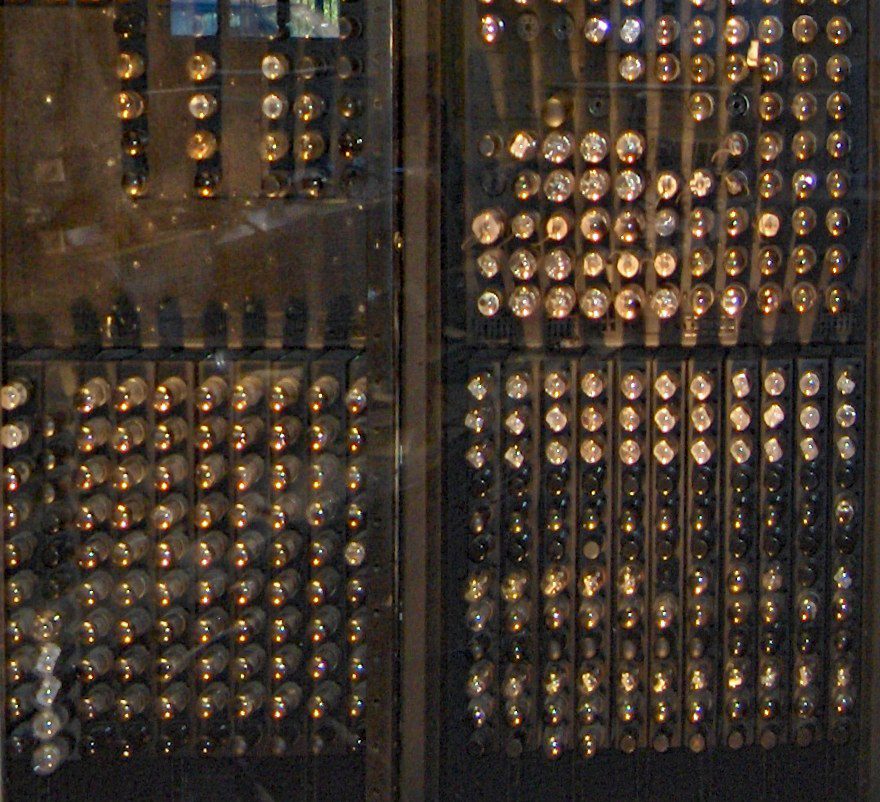
Then there is size. A tube is a glass bottle with a vacuum in it, and a vacuum needs a certain volume to hold electrodes apart. The smallest practical tubes were the size of a thumb, and no amount of ingenuity made them the size of a grain of rice. A computer's power is set by how many switches it has, and with tubes, every switch was a thumb-sized, two-watt, glass object with a lifetime of a few years and a warm-up time of thirty seconds. You could build ENIAC. You could not build anything a hundred times bigger, and by the late 1950s engineers had a name for the wall they had hit. Jack Morton of Bell Labs called it the tyranny of numbers in 1958. Every extra switch added cost, heat, failure rate, and thousands of hand-soldered joints, and the joints failed too.
Try it below. Pick a technology and a number of switches, and see what the machine would cost you in power, space, and reliability. Then slide up to the 76 billion switches of the graphics card that this series is about.
A machine made of switches. Rough figures for each technology: power per switch, volume per switch, how long each one lasts, and how fast it flips. The tube lifetime is ENIAC's, with derated heaters and the machine never switched off, which is far better than a tube's rated life.
| built from | power | takes up | a switch fails every | flips per second |
|---|
About the last row's lifetime figure: nobody measures single transistors, because they do not fail one at a time. The chip industry qualifies whole chips, in a unit called the FIT, one failure per billion hours of operation, as defined by JEDEC, the body that sets these standards. A modern chip is engineered to a failure rate of some tens of FIT. Divide a 20 FIT chip by the RTX 4090's 76 billion transistors and one transistor's share works out around 1019 hours. Treat it, like every number in this table, as an order of magnitude.
The figures are rough, the trend is not. Tubes and relays are fine up to a few thousand switches, marginal at tens of thousands, and impossible beyond. Yet everything interesting a computer can do, including everything in this series, needs millions of switches at the very least. The tube got computing started and then stood in its way.
How the transistor fixed it
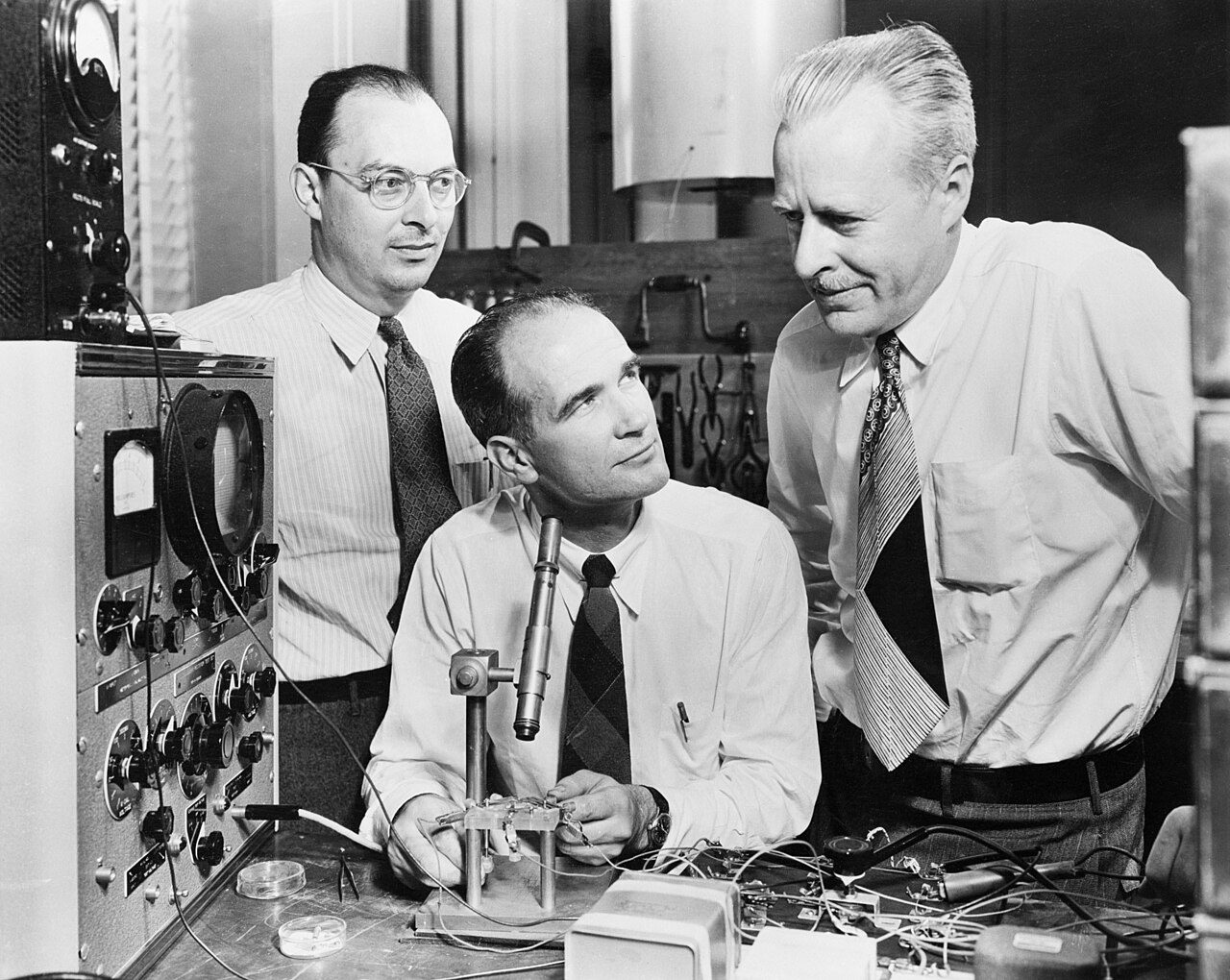
In December 1947 at Bell Labs, John Bardeen and Walter Brattain built the strangest-looking device in this series, and it is worth picturing properly. They took a small triangle of plastic and wrapped a strip of gold foil over its point, then cut the foil at the very tip with a razor blade, leaving two gold edges separated by a gap the width of a hair. They pressed the point down onto a sliver of germanium, a semiconductor, with a bent spring, so that the two gold edges became two contacts touching the germanium almost at the same spot, and a third contact sat under the slab. Then they found what they were hoping for: a small signal fed into one gold contact came out of the other one larger. Power gain, the triode's trick, from a lump of solid material with no vacuum, no glass, and nothing glowing.
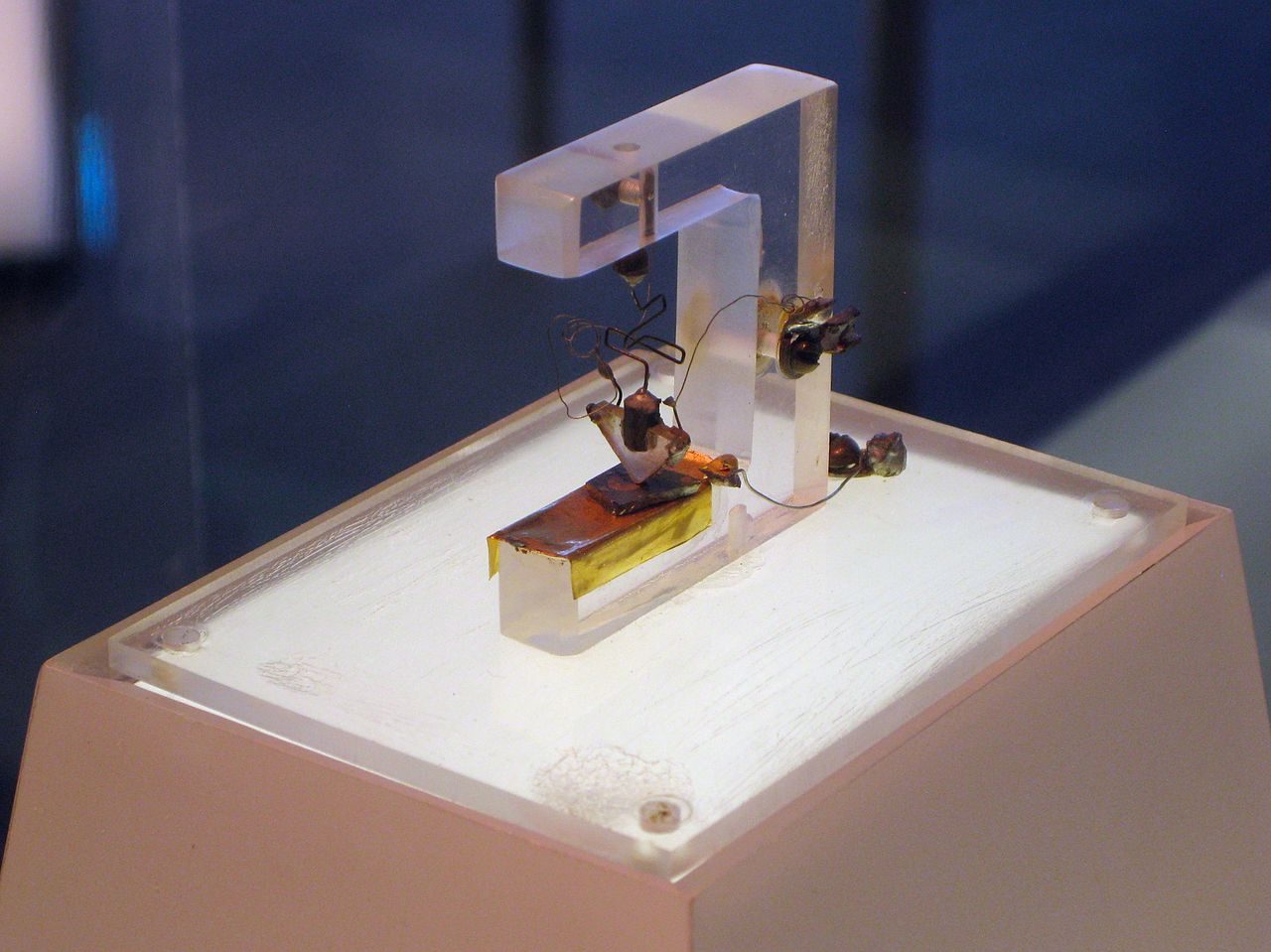
The contraption was temperamental, noisy, and nearly impossible to make twice the same way. Their boss, William Shockley, furious at having missed the discovery moment, spent the next month working out the theory and a better design: no delicate points at all, but a sandwich of three semiconductor layers, a thin base layer between an emitter and a collector, where a small current fed into the thin middle layer controls a large current flowing through the whole stack. The junction transistor was demonstrated in 1950, it was rugged and manufacturable where the point-contact was fussy, and it is the design that filled radios and computers for the next twenty years. The three men shared the Nobel Prize. What the transistor did was nothing new: a small signal controlling a large one, the triode's job exactly. What was new was what it did not need.
It did not need a heater, and the reason deserves a moment, because it is the whole point of the word semiconductor. In a metal, a fraction of every atom's electrons are unattached, a sea of them, free to drift the moment a voltage asks, which is why a metal always conducts. In an insulator such as glass, every electron is locked to its atom, and nothing short of destruction will free them. Silicon and germanium sit in between: pure, at room temperature, they have almost no free electrons and barely conduct at all. The trick that makes them useful is called doping. Sprinkle the crystal with a trace of a neighbouring element, one atom in a million, and you set the number of mobile charges by recipe: phosphorus brings one spare electron per atom, boron brings one vacancy that behaves like a mobile positive charge. Chemistry, not heat, decides exactly how many carriers exist and in which regions.
Now compare the starting points. The tube had to boil its electrons off a hot cathode to get them into a vacuum where a grid could steer them, and paid a couple of watts, thirty seconds of warm-up, and an eventual burnout for the privilege. The transistor's mobile charges are built into the solid by chemistry, already sitting where junctions and fields can steer them, at room temperature. No heater, so no warm-up, no burnout, and a thousandfold less power before anyone had tried to optimise anything: early transistors used milliwatts against a tube's watts. It did not need a vacuum or a glass envelope either, so it was rugged and could be made small: the first commercial transistors were the size of a pea, and, unlike the tube, there was no physical reason they could not be made smaller still. A transistor that is kept within its ratings does not wear out at all, which turned the tyranny of numbers on its head. A machine with a million transistors is not a machine with a million things waiting to fail.
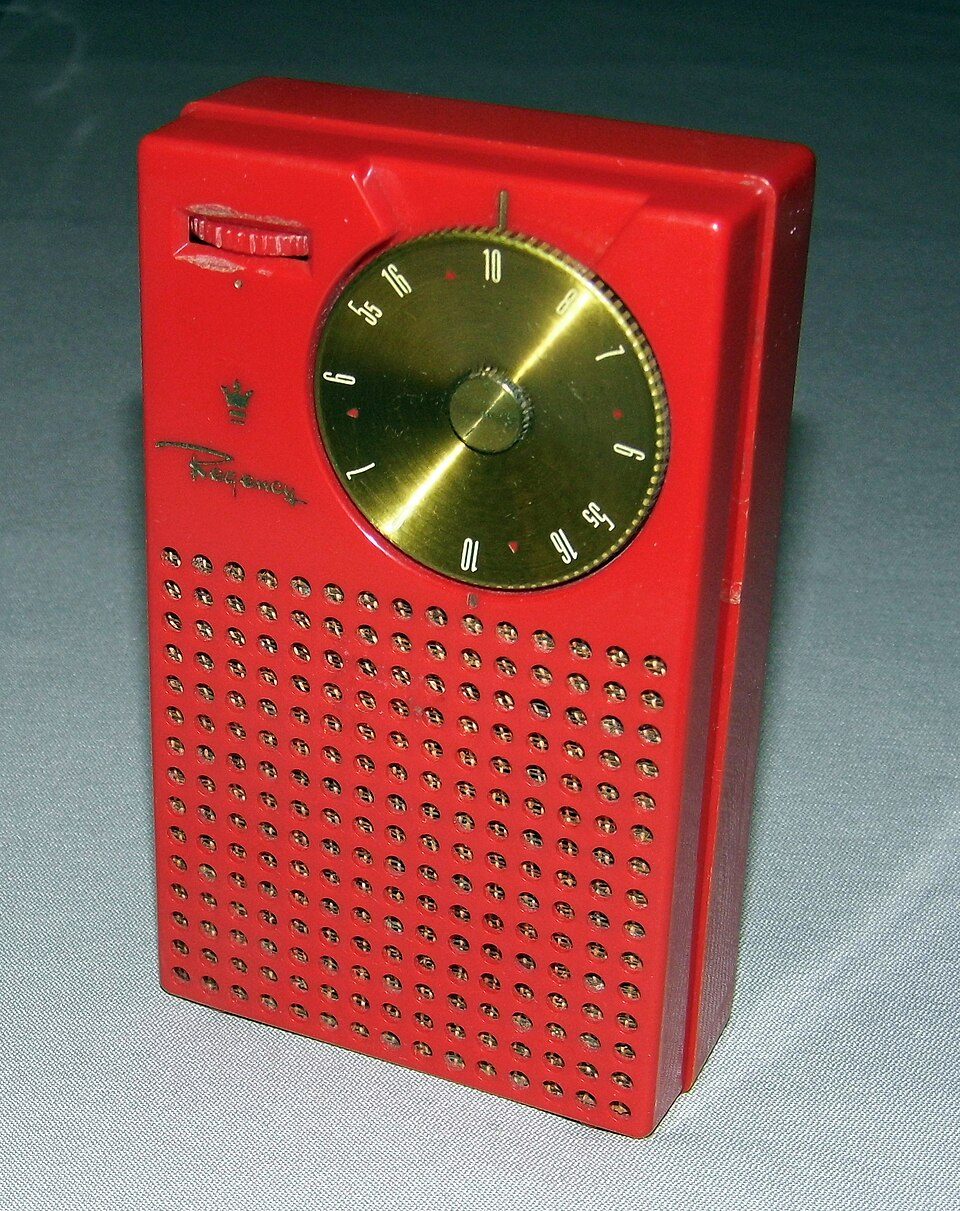
The transistor had its own problems, and for a decade the tube kept its jobs. Early germanium transistors were expensive, around eighteen dollars each in 1950 against seventy-five cents for a tube, and their behaviour drifted with temperature. They could not handle high power or high frequencies, which is why transmitters, radar, and anything with kilowatts stayed with tubes, and why the microwave oven still does. And they were noisy in the electrical sense. So the transistor won its first markets where small and low-power mattered more than anything else: hearing aids, which people had been carrying around with a tube amplifier and a battery pack the size of a book, took their first transistor in 1952 and had gone almost entirely transistor by 1954. That year also brought the Regency TR-1, the first commercially made transistor radio, with four transistors, which sold for about fifty dollars and made the word "transistor" mean "radio" for a generation. The first transistor computer ran at Manchester University in 1953, Bell Labs' TRADIC followed in 1954 with 684 transistors (and one tube, to generate its clock), and by 1959 IBM's 7090 mainframe was transistorised. No serious computer used tubes again.
Two further steps made the transistor into the switch this series is about, and each deserves its own picture.
Printing the wires: the integrated circuit
Replacing tubes with transistors shrank the switches but not the problem, because the wiring stayed. A late-1950s computer was still tens of thousands of separate components, every one placed and soldered, and every joint a place to fail. The tyranny of numbers had moved from the tubes to the joints.
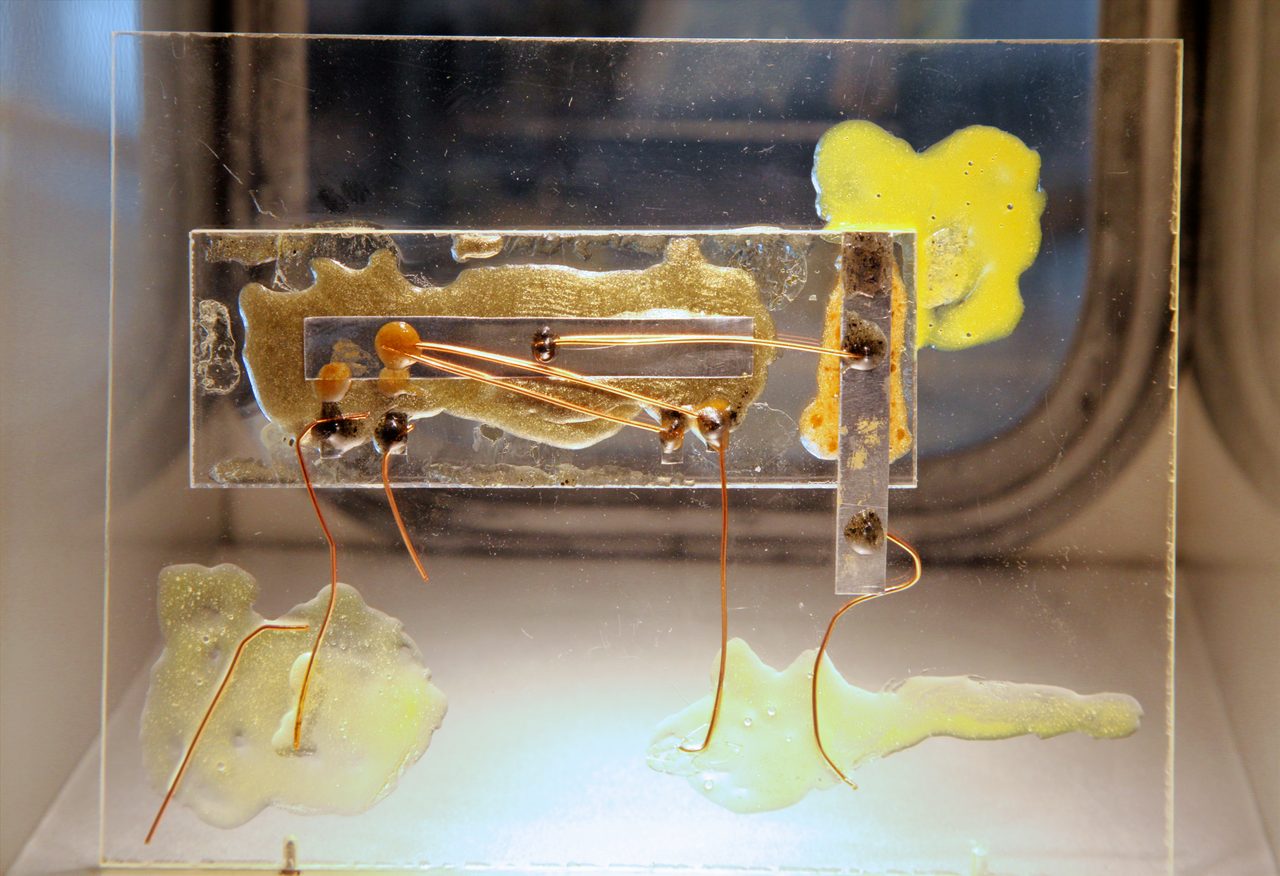
In the summer of 1958 Jack Kilby, newly arrived at Texas Instruments and with no holiday to take, was left alone in the lab with the problem. His insight was that the other components on a circuit board, the resistors and capacitors of Part 1's side note, could all be made, less well but well enough, out of the same semiconductor as the transistors, which meant an entire circuit could be built in one piece with nothing to solder. On 12 September 1958 he demonstrated it: a whole working oscillator on a single sliver of germanium. One piece, but not yet one process: his components were joined by fine gold "flying wires", attached by hand under a microscope.
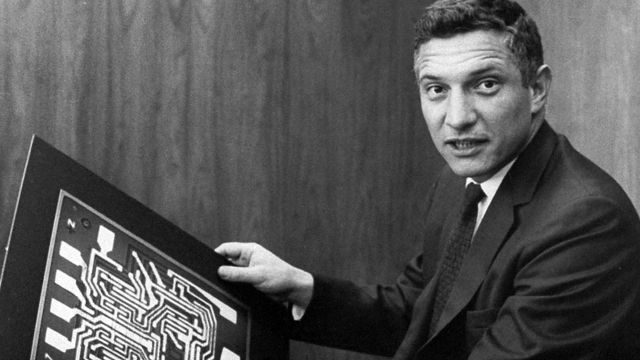
The finishing move came at Fairchild. Jean Hoerni's planar process made transistors flat, buried under a smooth, glassy skin of silicon dioxide, and in 1959 Robert Noyce saw what the flatness allowed: open small windows in the glass, then deposit aluminium tracks across the top, shaped photographically like everything else. The wires stopped being things a person attached and became one more printed layer. Fairchild had working chips built this way by 1961, and that is the integrated circuit as it still is: components and their wiring made together, by light, with no hands anywhere. The soldered joints disappeared the way the tubes had, cost per component began the collapse that has not stopped since, and Part 3 picks the story up from there.
The transistor that scales: the MOSFET
The junction transistor has one habit that did not matter for a radio and matters enormously for a computer: it is worked by a current. To hold it on, you must keep feeding current into its thin base layer, and that current is spent, turned to heat, by every single switch, all the time. A few hundred transistors can afford it. A billion cannot.
In 1959, at Bell Labs, Mohamed Atalla and Dawon Kahng built a transistor that goes back to the triode's best idea. The grid never touched the electron stream, it steered by electric influence alone, and their device does the same inside a solid: a metal gate sits above the current's path, separated from it by a whisker-thin layer of glass, and the gate's electric field, acting through the insulation, opens and closes the channel underneath. No current flows into the gate at all, beyond the instant of switching. That is the MOSFET, and silicon handed it a gift that no other material offered: silicon's own oxide, the "rust" that grows on its surface, happens to be a nearly perfect insulator, the very glass the gate needs, and the same glassy skin the planar process prints its wires on.
The MOSFET was slower than the junction transistor at first and nobody important wanted it, but it had the two properties that decide everything at scale. Holding its state costs essentially nothing, especially after 1963, when Frank Wanlass worked out how to pair each MOSFET with an opposite twin so that one of the two is always off, the arrangement called CMOS that Part 4 will meet, in which a circuit draws real current only at the instant of switching. And it is flat, made entirely of printed planar layers, so every improvement in printing makes it smaller with no redesign of the idea. It draws almost nothing, it shrinks better than anything else ever invented, and there are 76 billion of them in the chip on the cover of this series.
Where you will find each one today
| Relay | Vacuum tube | Transistor | |
|---|---|---|---|
| How it switches | an electromagnet moves a contact | a grid voltage throttles an electron stream in a vacuum | a gate voltage opens a channel in solid silicon |
| Flips per second | hundreds | up to millions | billions |
| Power per switch | around a watt, to hold the arm | a few watts, mostly the heater | nanowatts on a chip |
| Size | a sugar cube | a thumb | a few dozen atoms across |
| Lifetime | millions of operations, then the contacts go | a few thousand hours, then the heater goes | effectively unlimited within ratings |
| Best at | switching big currents with total isolation | very high power at very high frequency | being small, cheap, cool, and numerous |
| Where it lives now | car starters, headlamps and horns, air conditioners, industrial machinery, lifts, substation protection, the click in a cheap timer | microwave ovens, X-ray machines, satellite and radar transmitters, particle accelerators, guitar amps, some hifi | every chip, every phone charger, every electric car's motor drive, every LED bulb, and the 76 billion in a GPU |
The pattern in the last row is the lesson of this part. Each technology kept the jobs where its particular strength mattered more than its weaknesses. The relay kept isolation and brute current. The tube kept extreme power and frequency. The transistor took everything where the count mattered, and it turned out that in computing, the count is the only thing that matters.
Where this leaves us
Electronics needed a component that lets a small signal control a large one. The relay of Part 1 did it with a magnet and a moving arm, and could switch a starter motor but not a radio signal. The tube did it with a heated cathode in a vacuum, could amplify anything, and built the first computers, but every one was a hot, thumb-sized, glass object with a lifetime of a few years, and that put a ceiling of tens of thousands on how many switches a machine could have. The transistor did the same job in a solid, with no heater, no vacuum, and no wearing out, and the ceiling disappeared. The tube and the relay are still around us, doing the jobs where they were never beaten. But the machine this series is about could only be built from the third.
So the next part starts where Stokes did, with the transistor as a switch: what a MOSFET is, why it can only be on or off, how it got from one to 76 billion, and what it costs, in heat, to flip it a few billion times a second.
Next: The Switch: the transistor as a switch, why computers count in twos, what "4 nanometres" does and does not mean, and the end of the free lunch that made GPUs inevitable.